69 $
| |
| Marking: | 97794 |
| Country: | USSR |
| Dating: | 1930-th year |
| The original. |
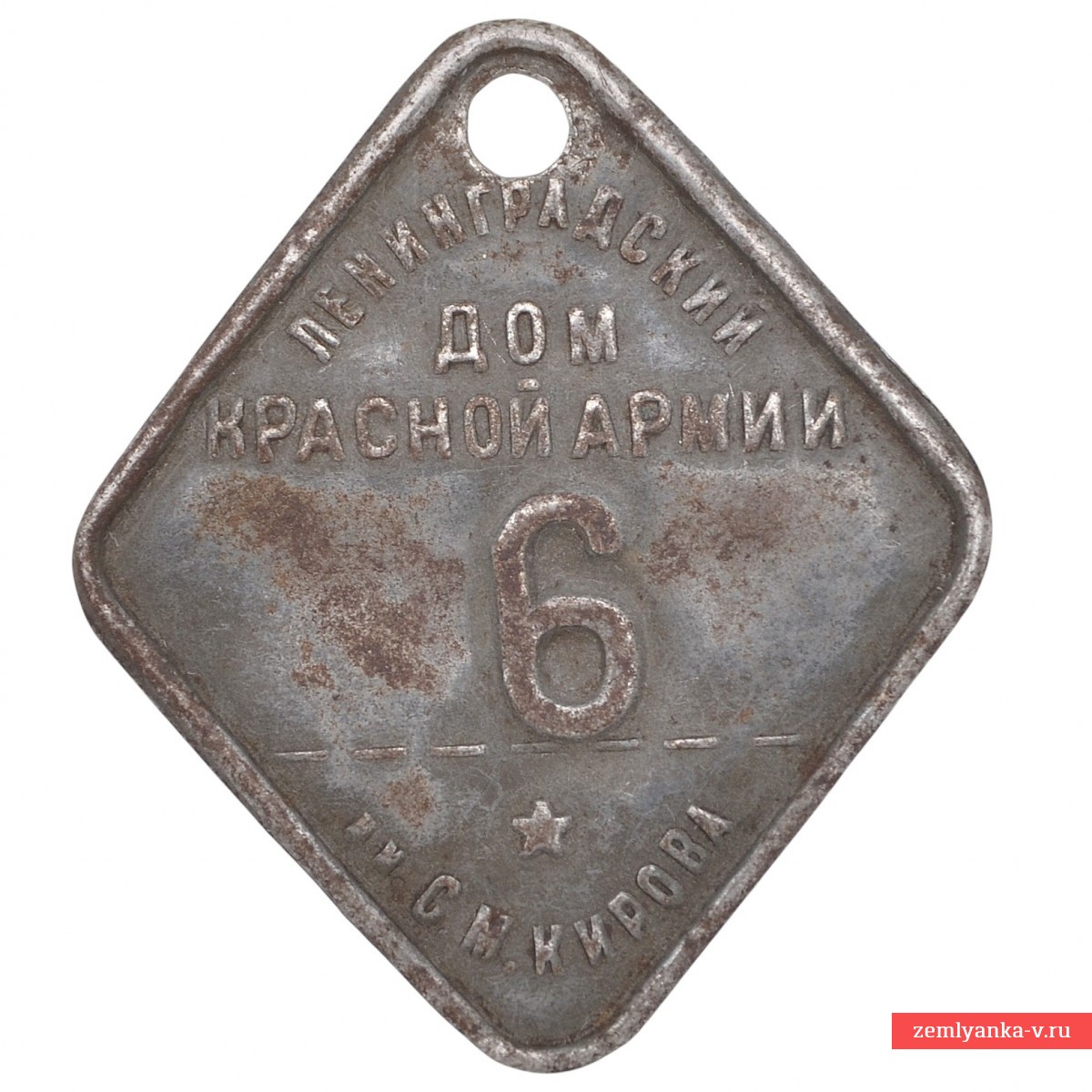
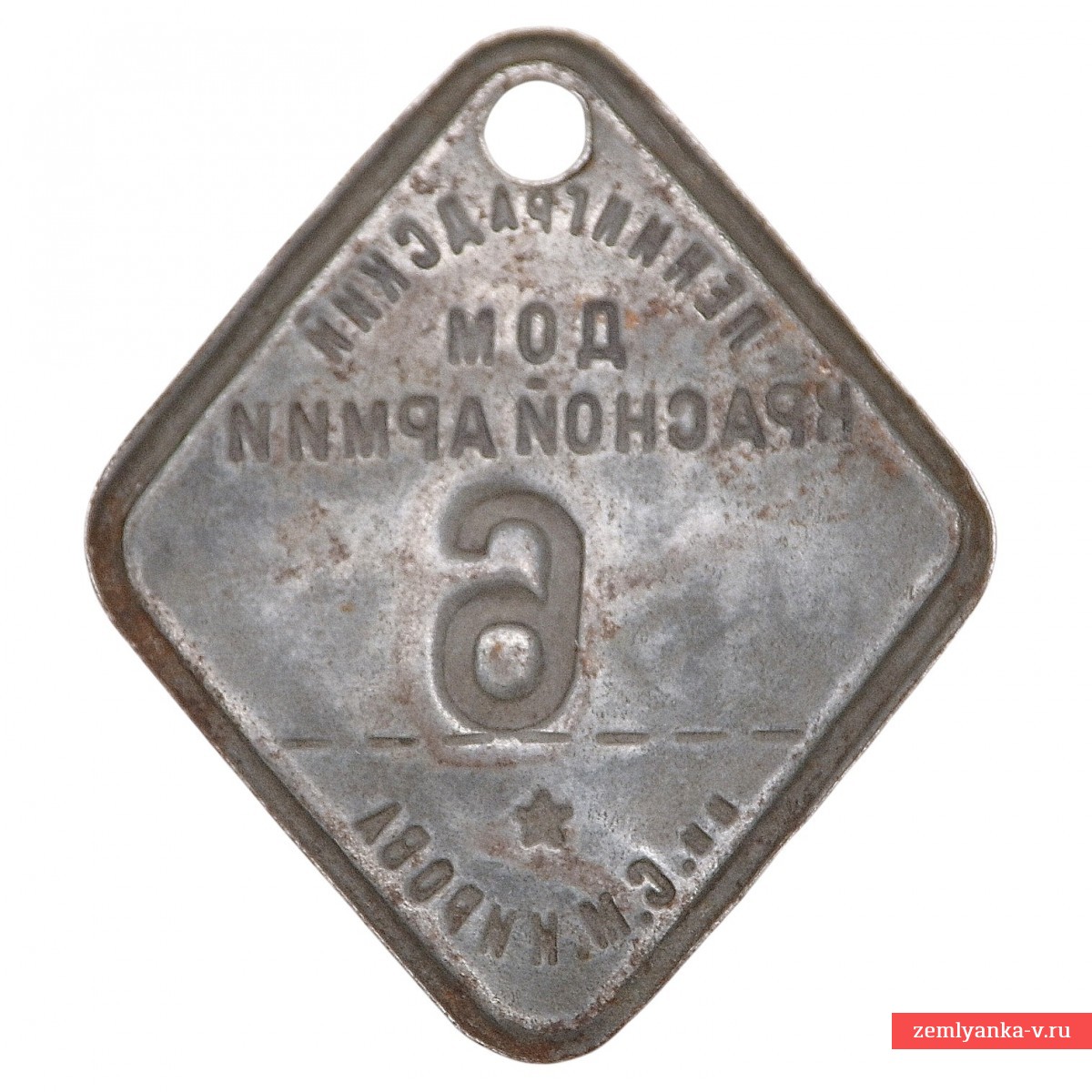
Steel, stamping. The original Soviet wardrobe badge (number) of the Leningrad House of the Red Army named after S. M. Kirov is in very good condition. A square-rhombic shaped token with rounded corners and a round hole in the upper part for hanging on a wardrobe hook. Relief inscriptions and elements are made on the front side by stamping: "LENINGRAD" is stamped in a semicircle in the upper part, and "HOUSE OF THE RED ARMY" is written in two lines below. The serial number of the hanger, the number "6", is printed in large font in the center. Under the number there is a horizontal dividing line of dotted lines, under which there is a small five-pointed star. At the very bottom, along the edge, there is an inscription in a semicircle: "NAMED after S. M. KIROV." Characteristic traces of use, patina and pockets of corrosion are visible on the metal surface. This badge is a living witness to the era of the 1930s and 1940s, when thousands of visitors deposited their overcoats and coats in the wardrobe of the LDKA, going to lectures, concerts or solemn meetings. The size is 46*53 mm. Guarantee of authenticity.
Leningrad House of the Red Army (LDKA). The history of this iconic cultural and educational institution is inextricably linked with the magnificent building in St. Petersburg at the corner of Liteyny Prospekt and Kirochnaya Street. The building was erected in 1895-1898 by decree of Emperor Nicholas II for the Officers' Assembly of the Army and Navy (architect A. I. von Gauguin). It served as the center of leisure, balls and education of the officer corps until the revolution of 1917. After the revolution, the Officers' Assembly was abolished. In early 1918, an entry point for volunteers in the ranks of the emerging Workers' and Peasants' Red Army was opened in the deserted halls. After changing several names and undergoing reorganization, on April 8, 1924, the institution officially opened as the Leningrad House of the Red Army (LDKA). In 1934, after the death of prominent Soviet statesman Sergei Mironovich Kirov, the House of the Red Army was named after him.
In the 1920s and 1930s, the LDKA conducted tremendous cultural and educational work among the Red Army and residents of the city: a huge library, lectures, clubs, concerts and exhibitions were held here. The historical significance of the LDKA was fully manifested during the Great Patriotic War and the siege of Leningrad. The building has become the most important military, ideological and cultural center of the besieged city.:
Front-line concert, art and propaganda brigades were formed here and went to the front line. There were junior lieutenant courses and special military courses at the LDKA base. The halls regularly hosted screenings, sports performances and exhibitions of artists that raised the morale of the defenders of the city (it was here that the famous painting "Meeting of Two Fronts" was first exhibited in 1943). In 1942, the legendary 500th concert of Claudia Shulzhenko took place in the great hall of the LDKA.
In 1944, the Leningrad House of the Red Army was awarded the Order of the Red Star and received the battle Flag for outstanding services in mobilizing forces to defeat the Nazi troops.
In the post-war years, due to the renaming of the Armed Forces, the institution was named the District House of Officers of the Leningrad Military District. Today, historical traditions continue within the walls of the Officers' House of the Western Military District, which remains one of the main monuments of military glory and culture of St. Petersburg.
Thanks for your feedback!
Your feedback will be published after administrator check.
Be attended, we will not show the feedbacks, which:
Please note that by posting a feedback you take some responsibility to the readers.