
31 $
| |
| Marking: | 96642 |
| Country: | USSR |
| Dating: | 1944 year |
| The original. |
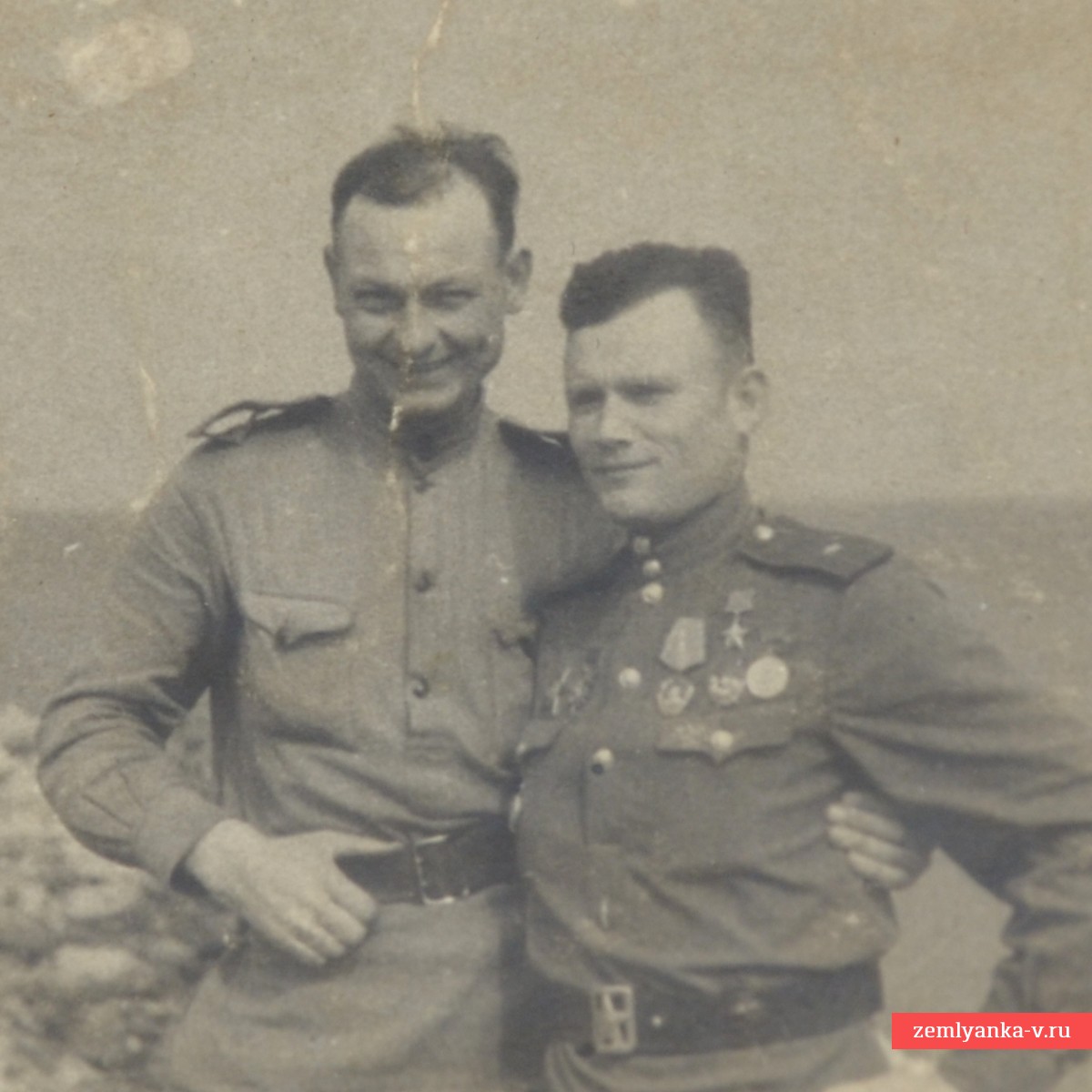
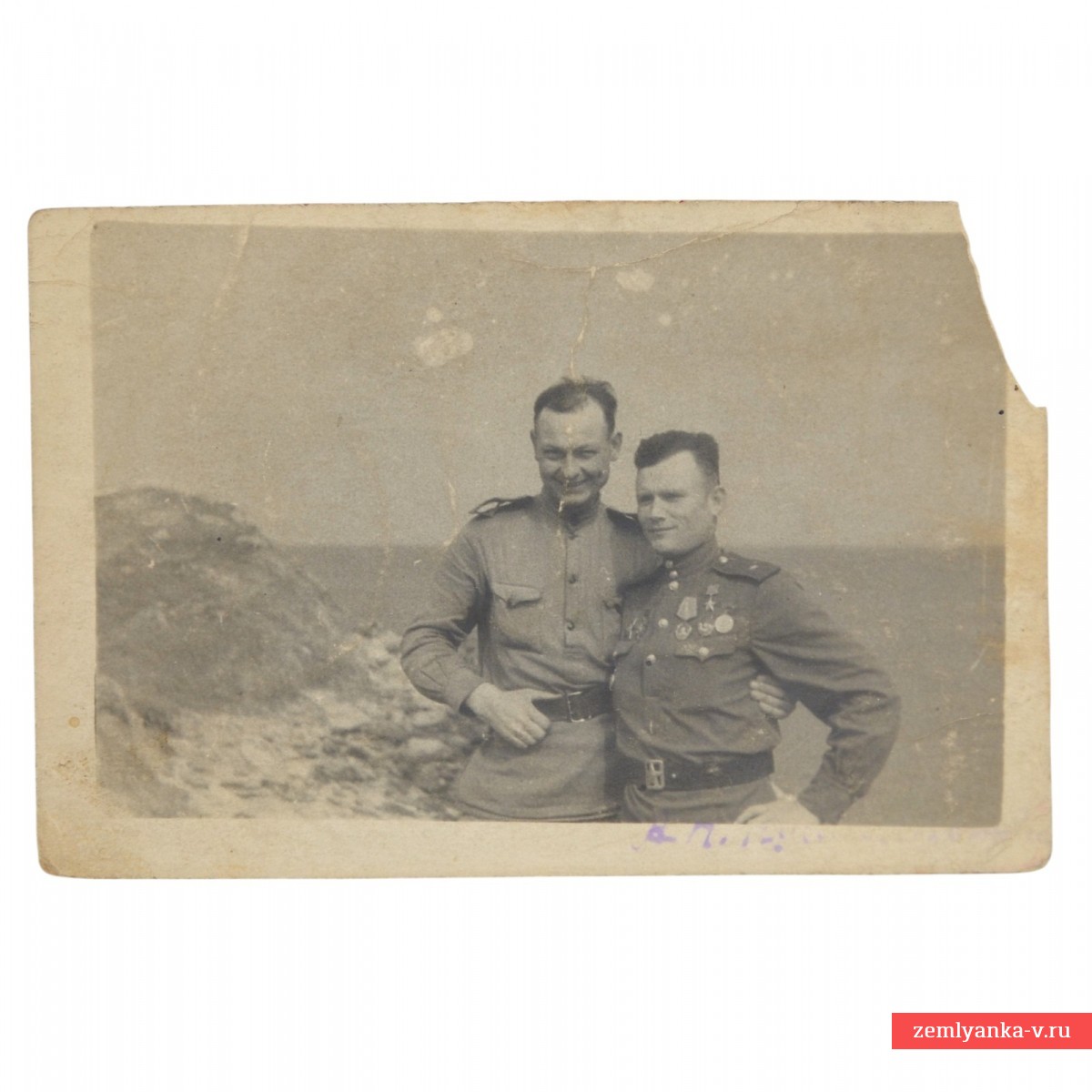
The original photograph is in satisfactory collector's condition. The size is 60*90 mm. On the reverse side is the Hero's signature. Guarantee of authenticity.
Anatoly Pavlovich Pushkarenko (1913-1964[1]) was a Soviet military officer. Participant of the Great Patriotic War. Hero of the Soviet Union (1944). Guard major. In the battles with the Nazi invaders, Lieutenant A. P. Pushkarenko from the first days of the war. Anatoly Pavlovich received his baptism of fire in battles on the Prut River near the village of Lipkany, Moldavian SSR, then participated in the defense of the city of Mogilev-Podolsky, retreated to Pervomaisk, where the division was surrounded. During the breakout from the boiler, Lieutenant A. P. Pushkarenko was wounded and was treated in the hospital for a long time. On March 8, 1942, he was back on the Southern Front. In the battles near the village of Ryazhenoe, Rostov region, on April 3, 1942, Anatoly Pavlovich was seriously wounded again and ended up in a hospital bed. After recovering in July 1942, he was assigned as a senior lieutenant to the 2nd Guards Rifle Division, where he was assigned as a senior adjutant to the headquarters of the 3rd Infantry Battalion of the 395th Guards Rifle Regiment. As part of his unit, A. P. Pushkarenko took part in the defensive battles for Belaya Kalitva and retreated to the North Caucasus. Since August 1942, Anatoly Pavlovich fought on the North Caucasian and Transcaucasian fronts in the Battle for the Caucasus. The regiment, in which senior Lieutenant A. P. Pushkarenko served in the Guards, managed to hold positions in the area of the village of Zayukovo and Mount Khara-Khora. Senior Lieutenant Pushkarenko distinguished himself in the battles for the village of Zayukovo on September 3, 1942. Commanding a group of battalion soldiers, he went to the eastern outskirts of the village, and within two hours, fighting with the German garrison, he managed to dislodge the enemy from the village. In mid-October, during the Nalchik-Ordzhonikidze defensive operation, the regiment was surrounded, but not only was able to break out of the ring itself, but also secured the exit of the headquarters of its 37th army, 295th Infantry Division and 11th NKVD Division near the village of Babugent. Without allowing the ring to close, the 3rd Infantry Battalion under the command of Guard Senior Lieutenant A. P. Pushkarenko repelled two enemy attacks on November 4, 1942, destroying 90 soldiers and officers of the Wehrmacht.
At the end of 1942, Senior Lieutenant A. P. Pushkarenko of the Guards was transferred to the post of deputy commander of the infantry battalion of the 395th Guards Infantry Regiment. On January 3, 1943, the regiment, as part of the 2nd Guards Rifle Division of the 37th Army of the Northern Group of Forces of the Transcaucasian Front, launched an offensive as part of the North Caucasian Offensive Operation. Anatoly Pavlovich received an order with a group of 70 fighters to penetrate into the enemy's rear and cut off his escape routes from the city of Nalchik. Pushkarenko's detachment successfully crossed the front line and on the morning of January 4 suddenly attacked the Germans in the village of Russian Baksan. During a fierce battle, the enemy garrison was defeated. The enemy lost up to 50 people killed, 3 vehicles and an armored personnel carrier. The documents of the German battalion headquarters located in the village fell into the hands of the Guards. A day later, in the battle for the village of Kyzburun, the 3rd[2] Anatoly Pavlovich was seriously injured and evacuated to the hospital.
On the night of November 3, 1943, on the boats of the Azov Military Flotilla, the assault battalion of the 1st Guards Rifle Regiment under the command of Guard Major A. P. Pushkarenko crossed the Kerch Strait in stormy weather and landed on the eastern shore of the Kerch Peninsula. Having overcome steep rocky ledges, the paratroopers swiftly attacked enemy positions near the village of Mayak and broke his resistance, destroying up to 120 soldiers and officers of the Wehrmacht. Having captured the bridgehead, Pushkarenko's battalion ensured the landing of other divisions of the division. In the battles to hold the bridgehead on November 3-5, 1943, Anatoly Pavlovich and his men repelled 10 counterattacks by enemy infantry and tanks, after which they launched an attack and stormed the strategically important height 175.0 and a large German defense stronghold, the village of Baksy. In fierce battles, A. P. Pushkarenko's battalion inflicted significant damage on the enemy, killing up to 135 German soldiers and capturing 16. The Guards seized 2 vehicles, an anti-aircraft battery, 7 machine guns and light machine guns, and a warehouse with ammunition and military equipment as trophies. When repelling enemy counterattacks near the village of Baksy on November 7, 1943, Anatoly Pavlovich was concussed, but did not leave the battlefield. Under his command, the battalion held the conquered borders. Major Pushkarenko Anatoly Pavlovich was awarded the title Hero of the Soviet Union by decree of the Presidium of the Supreme Soviet of the USSR dated November 17, 1943, for seizing a bridgehead on the Kerch Peninsula and showing bravery and heroism.
In April 1944, the troops of the Separate Primorsky Army launched an offensive from the bridgeheads held on the eastern shore of the Kerch Peninsula as part of the Crimean operation. Having broken through the enemy's defenses, the battalion of the guard of Major A. P. Pushkarenko, acting by landing on tanks, rushed deep into the Crimean peninsula. In one of the battles Anatoly Pavlovich was seriously concussed. He never returned to the front. After treatment in the hospital, Pushkarenko served in the rear units until the end of the war. On June 24, 1945, as part of the consolidated column of the Separate Primorsky Army, he took part in the Victory Day Parade on Moscow's Red Square. After the war, Anatoly Pavlovich continued to serve in combat units of the Red and Soviet Armies. Major A. P. Pushkarenko has been in the reserve of the Guard since 1953. Anatoly Pavlovich lived in the city of Odessa. He served in the Interior Ministry. On November 20, 1964, A. P. Pushkarenko died. He was buried at the 2nd Christian Cemetery in Odessa.
Thanks for your feedback!
Your feedback will be published after administrator check.
Be attended, we will not show the feedbacks, which:
Please note that by posting a feedback you take some responsibility to the readers.