56 $
| |
| Marking: | 96202 |
| Country: | USSR |
| Dating: | 1944 year |
| The original. |
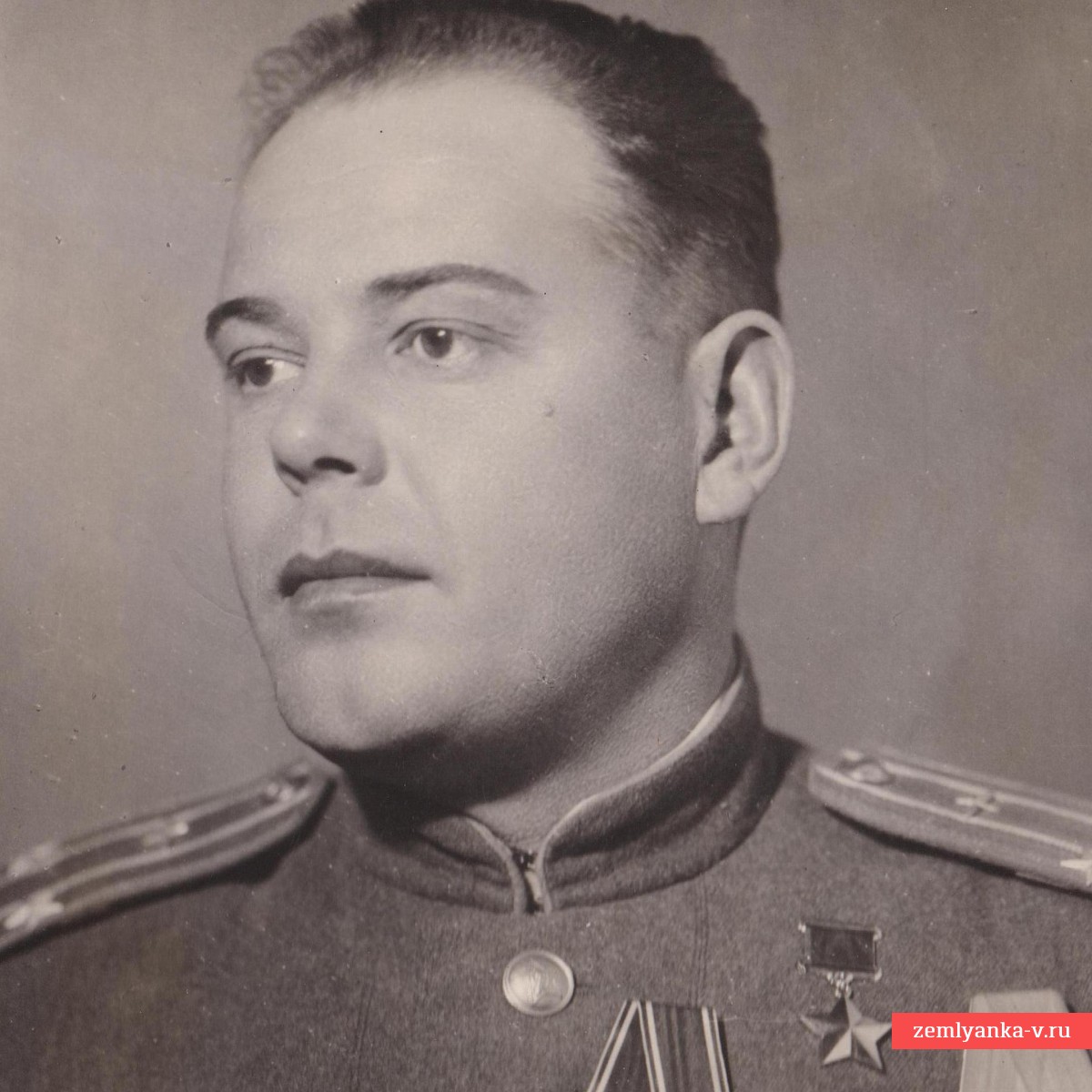
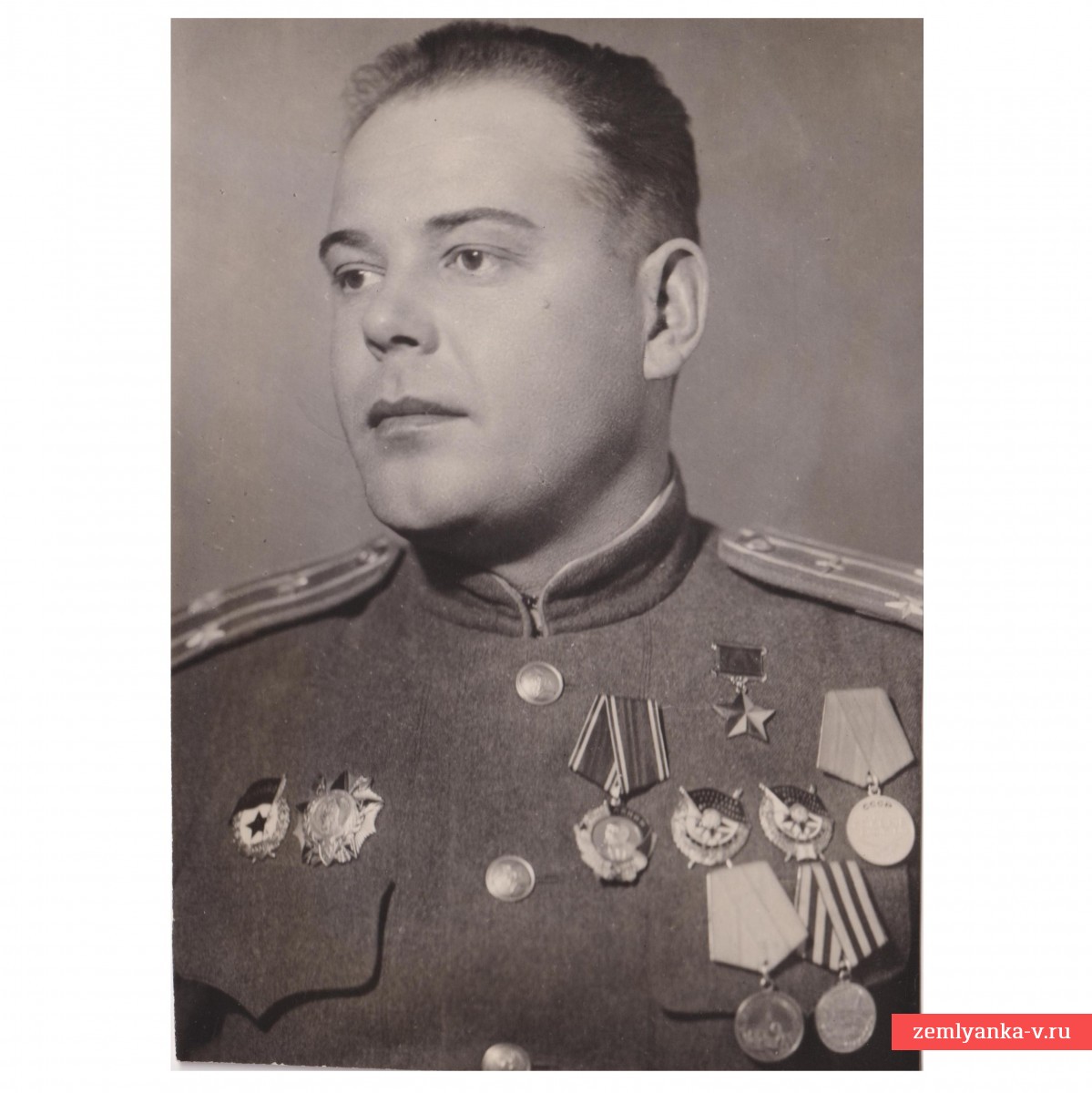
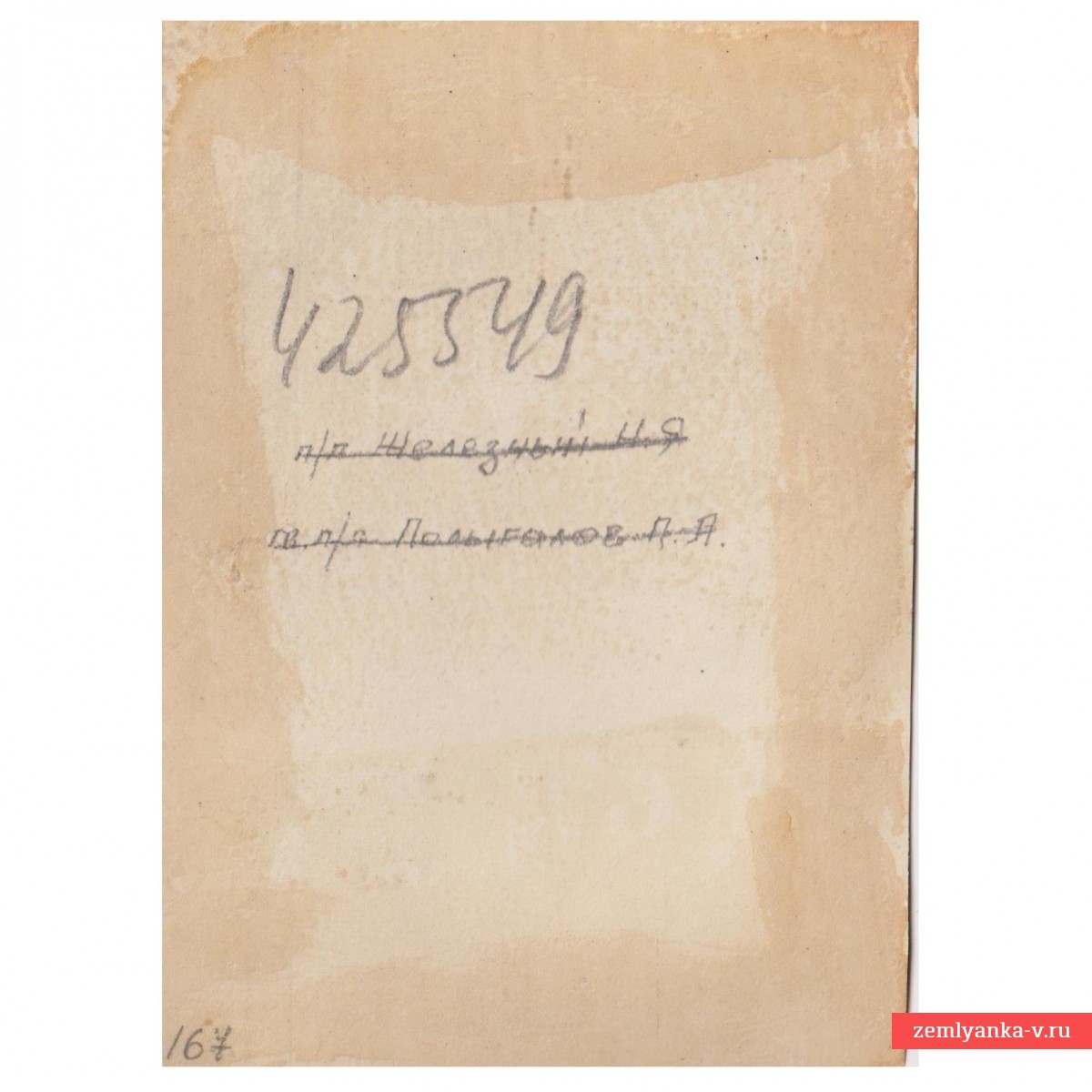
The original photo is in excellent collector's condition. The size is 93*131 mm. Guarantee of authenticity. It's rare.
Pavel Andreevich Polygalov (1912-1968) was a Soviet military aviation navigator. Participant of the Great Patriotic War. Hero of the Soviet Union (1944). The Colonel. In the battles with the Nazi invaders, the captain served as navigator of the ship from September 7, 1941. During the war, Pavel Andreevich fought on EP-2, TB-3, R-5, PS-84, SB, Il-4 and B-25 aircraft. During 1941, as a navigator, he flew 18 combat missions to bomb concentrations of enemy troops and its military infrastructure in conditions of the overwhelming advantage of the Germans in the air. On October 9, 1941, during a raid on the Smolensk railway junction on a Polygalov aircraft, one engine was damaged by anti-aircraft artillery fire. However, this did not prevent Pavel Andreevich from precisely taking the plane to the target. Upon returning to their airfield, the crew was forced to abandon the aircraft that caught fire over the territory occupied by the enemy. After 12 days, the crew crossed the front line and returned safely to the unit.
In December 1941, the 421st Long-range Bomber Regiment was transformed into the 747th Long-range Aviation Regiment as part of the 3rd Long-range Aviation Division. From mid-February 1942, acting from the Kratovo airfield in the interests of the Northwestern, Kalinin, Western and Bryansk fronts, Captain P. A. Polygalov, navigator of the Er-2 ship, participated in raids on enemy troop concentrations and bombing of railway junctions, military echelons and enemy airfields. Pavel Andreevich flew his bomber to targets in Vitebsk, Minsk, Orsha, Yartsevo, Vyazma, Smolensk, and also participated in reconnaissance flights in the near and deep rear of the enemy. In June 1942, Captain Polygalov was one of the first in long-range aviation to master the route for transporting B-25 aircraft from Iraq to the USSR. Since the summer of 1942, Pavel Andreevich fought on the B-25 aircraft in the crew of A. A. Balenko. In the period from 07/25. to 09.09.1942, navigator Polygalov participated in four raids on Konigsberg and one raid on Danzig. In August 1942, the regiment in which Polygalov served participated in the battles in the Stalingrad direction. The crews of the regiment were forced to be used as front-line bombers, and therefore the regiment suffered heavy losses. In one of the battles, Polygalov's B-25 was also shot down, but the crew managed to reach their territory and parachute out. In November 1942, Pavel Andreevich participated in special assignments of the command to scatter leaflets in the area of Kramatorsk, Stalino, Makeyevka and Ordzhonikidze, during which more than ten million pieces of propaganda materials were dropped.
In June 1943, the 22nd Guards Long-range Aviation Regiment was formed from the remaining five crews of the 747th Aviation Regiment and the 15th Guards Long-range Aviation Regiment as part of the 5th Guards Aviation Division of the 4th Guards Long-range Aviation Corps. Polygalov, who had become a major by this time, was appointed to the post of navigator of the regiment. In the summer of 1943, the regiment participated in the Battle of Kursk, and in the fall of 1943, the Guards led groups of TB-7 bombers to enemy military installations in Smolensk and Orsha. In the spring of 1944, Pavel Andreevich participated in the Uman-Botoshan operation of the 2nd Ukrainian Front. In the summer of 1944, the 22nd Guards Aviation Regiment participated in Operation Bagration in the Bobruisk area. Guard Major P. A. Polygalov especially distinguished himself in the early days of the Red Army offensive in Belarus. During the bombing of enemy targets in the Village on June 23 and 24, 1944, he was in the sectors of anti-aircraft artillery fire for about an hour each time, highlighting targets, for which he was thanked on behalf of the Supreme Commander.
In August 1944, the 4th Guards Long-range Aviation Corps was deployed to Ukraine and took part in the Iasi-Kishinev operation. As a rule, he participated in combat missions as a guidance leader and controller of a regiment and division. At the same time, Pavel Andreevich participated in special command assignments, which consisted of delivering weapons, ammunition, medicines and other military supplies to the Yugoslav People's Army. In total, by October 1944, Guards Major P. A. Polygalov had flown 190 combat missions, including 4 sorties to Konigsberg, 1 sortie to Danzig, 3 sorties to Helsinki and 16 sorties to the Yugoslav partisans. Pavel Andreevich flew 55 combat missions as the leader of aircraft targeting and the controller of the regiment and division. During his combat work as the regiment's navigator, the 22nd Guards Long-range Aviation Regiment flew 2,810[6] combat missions. Having started working with five crews in 1943, Guards Major Polygalov led the actions of the navigators of twenty-eight crews by October 1944. During this time, Pavel Andreevich provided good training for young navigators in the regiment and personally prepared 32 pilots for navigation work. By decree of the Presidium of the Supreme Soviet of the USSR dated November 5, 1944, he was awarded the title Hero of the Soviet Union for the exemplary performance of combat missions of the command on the front of the struggle against the German invaders and the bravery and heroism shown at the same time. Soon he was awarded another military rank, Lieutenant colonel.
In December 1944, in connection with the reform of long-range aviation, the 22nd Guards Aviation Regiment was transformed into the 238th Guards Sevastopol Bomber Aviation Regiment as part of the 15th Guards Bomber Aviation Division of the 4th Guards Bomber Aviation Corps of the 18th Air Army. In the last months of the war, Lieutenant Colonel P. A. Polygalov flew seven more combat missions, including bombing military installations and railway junctions in Veszprem (Hungary) and Znojmo (Czechoslovakia). His total flight time was 1,392 hours, of which 830 hours of combat flight time. Pavel Andreevich completed his military career on May 9, 1945 at the Tekel airfield in Hungary.
After the war, he continued to serve in the Soviet Air Force. In 1953, he graduated from the Higher Flight Tactical School of Long-Range Aviation Unit Commanders (Ivanovo) and was awarded the military rank of colonel. After being discharged from the reserve in 1959, Pavel Andreevich lived and continued to work in the Ostafievo aviation garrison of the Leninsky district of the Moscow Region (now the Ostafievo subdistrict of the Novomoskovsky administrative district of Moscow). Pavel Andreevich died on October 4, 1968. He was buried on the Alley of Heroes of the Krasnaya Gorka cemetery in Podolsk.
.Thanks for your feedback!
Your feedback will be published after administrator check.
Be attended, we will not show the feedbacks, which:
Please note that by posting a feedback you take some responsibility to the readers.