Sold
| |
| Marking: | 96201 |
| Country: | USSR |
| Dating: | 1944 year |
| The original. | |
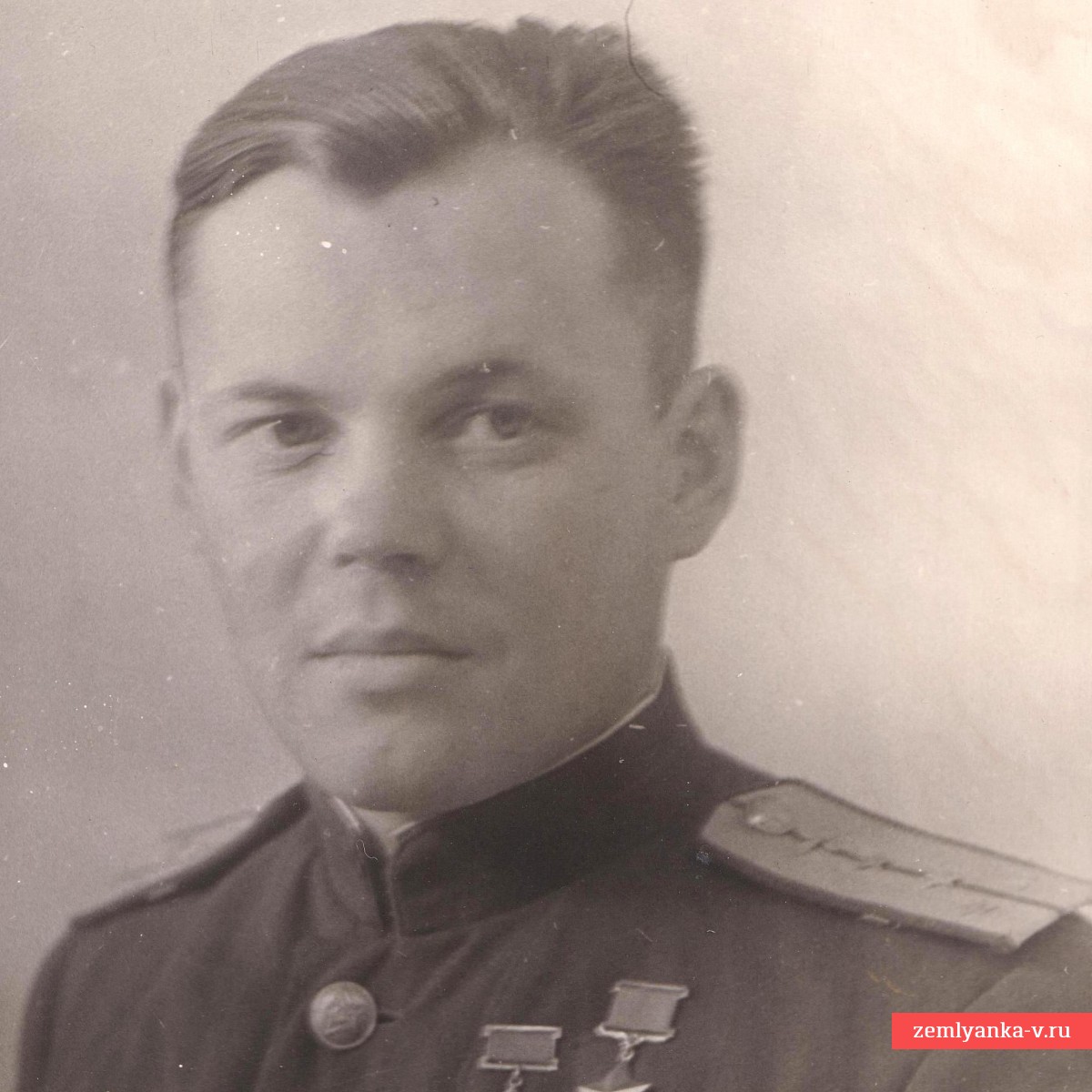
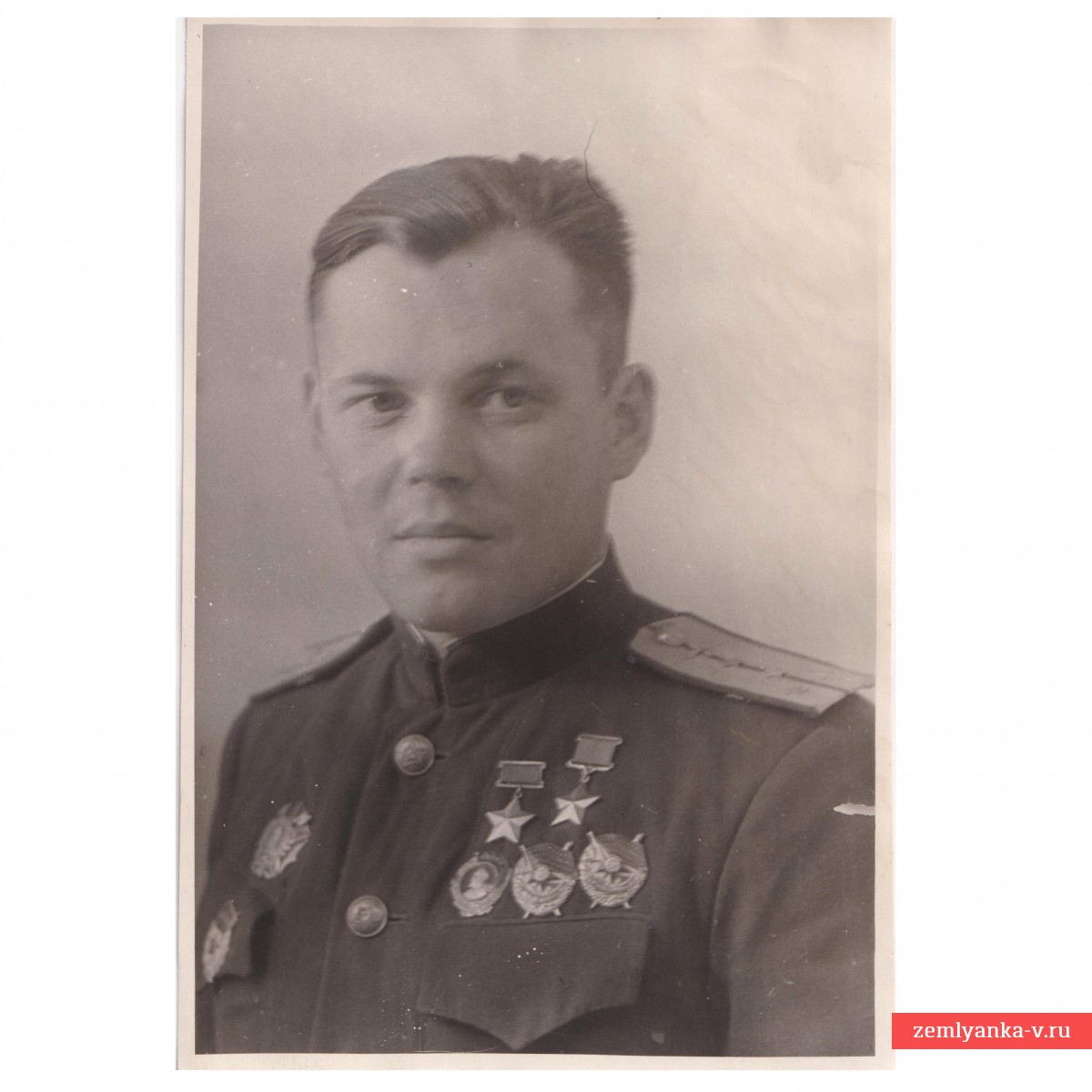
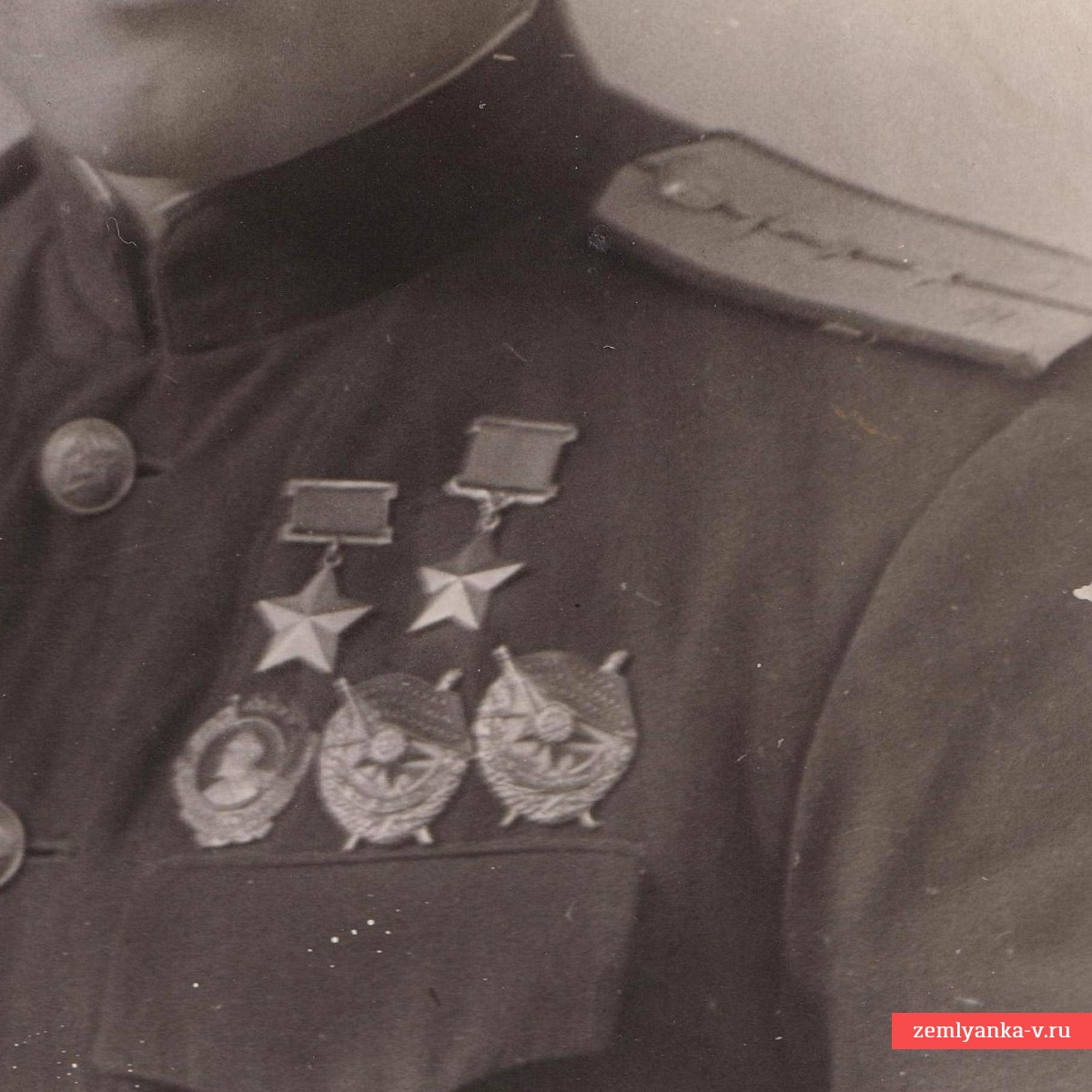
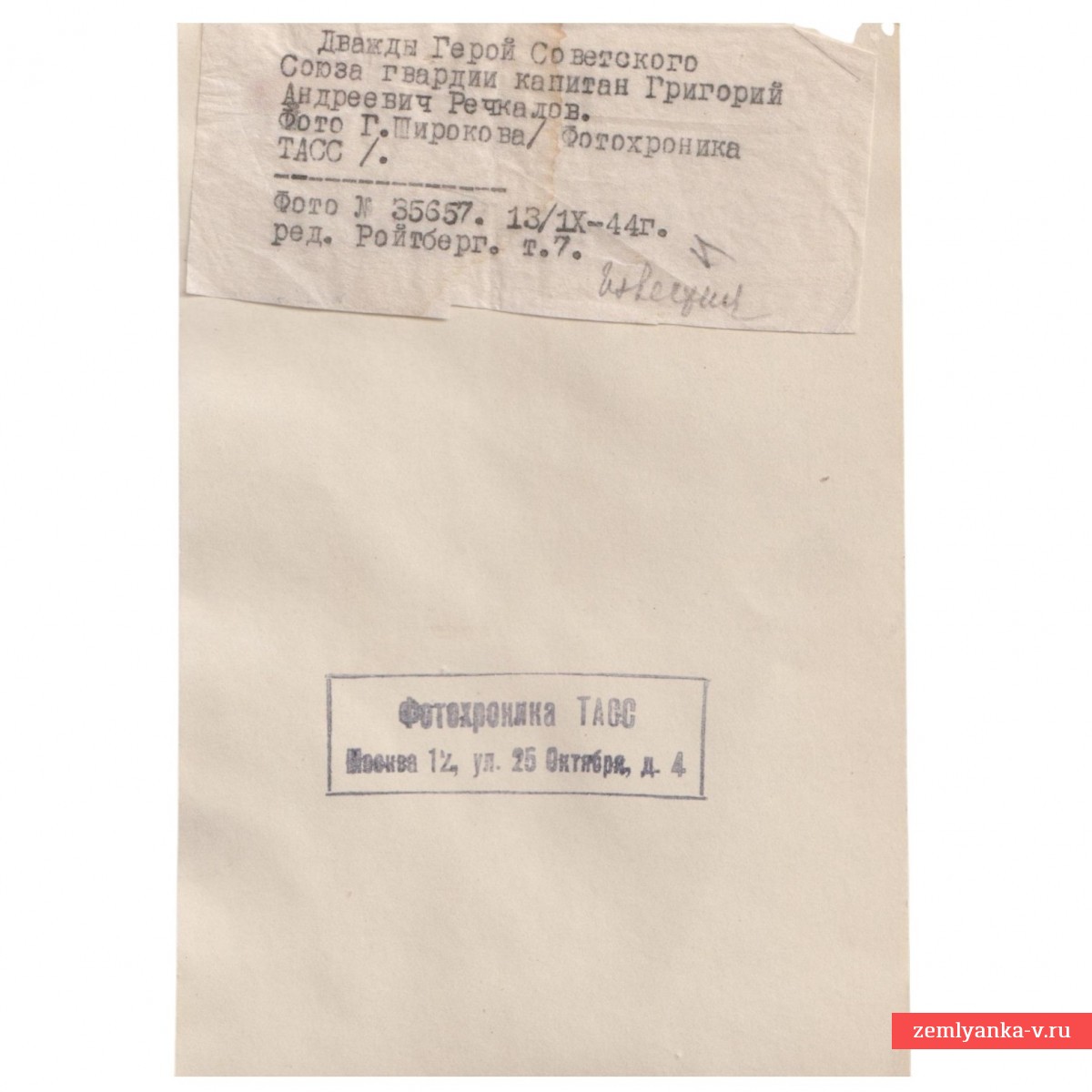
The original photo is in excellent collector's condition. The TASS newsreel. Photo by G. Shirokov. The size is 112*170 mm. Guarantee of authenticity. It's rare.
Grigory Andreevich Rechkalov (February 9, 1918 or 1920— December 22, 1990) was an aviation major general, twice Hero of the Soviet Union (1943, 1944).
He was born in the village of Khudyakovo in the Irbitsky district of the Perm province (now the village of Zaikovo in the Irbitsky district of the Sverdlovsk region) in a peasant family. When Grigory Rechkalov was in school, his family moved to the village of Bobrovka near Sverdlovsk, and he finished 6th grade there at a school in the village of Bolshoy Istok. At the age of 14, he began working as an electrician at a local mill. Later, he moved to Sverdlovsk and entered the school of factory apprenticeship at the Verkhny Isetsky Plant. At the same time, Rechkalov began studying in a gliding club.
In 1937, according to a Komsomol permit, he was sent to the Perm Military School of Pilots and in 1939, with the rank of sergeant, he was enrolled in the 55th Aviation Fighter Regiment in Kirovograd. During his service in the regiment, he participated in the campaign against Bessarabia. On the eve of the Great Patriotic War, the regiment was based on the outskirts of the city of Balti.
The day before the start of the war, Rechkalov underwent a medical flight examination and was rejected due to his color blindness. However, on June 22, when he returned to the unit, the chief of staff of the regiment gave him an urgent task to deliver documents and did not even look at the medical report. At the beginning of the war, he flew the I-153 Chaika fighter. He scored his first aerial victory on June 27, shooting down an Me-109 rocket. Already in the first month of the war, Grigory Rechkalov shot down 3 enemy aircraft, was wounded himself, but brought the plane to the airfield. He was sent to a hospital, and then to a reserve aviation regiment to master Yak-1 aircraft, but in April 1942 he fled to his regiment, which by that time had received the rank of Guards and became known as the 16th Guards Fighter Aviation Regiment (16 GuIAP).
In the regiment, he mastered the American fighter "Aerocobra". On December 30, 1942, by order of the commander of the Transcaucasian Front, he was awarded the Order of the Red Banner "for 4 personally shot down and 2 as part of a group of enemy aircraft and for 197 successful sorties." In the spring of 1943, the regiment joined the battles with the enemy in the Kuban. During the first two weeks of the fighting, Grigory Rechkalov shot down 19 enemy aircraft, and in three sorties he shot down 2 aircraft, and in one — 3. On May 5, 1943, "for 25 combat sorties carried out on an Aerocobra aircraft in the Kuban from 6 to 22.04.43 and personally shot down 3 enemy aircraft" He was awarded the second Order of the Red Banner.
By Decree of the Presidium of the Supreme Soviet of the USSR "On awarding the title Hero of the Soviet Union to the commanding staff of the Red Army Air Force" dated May 24, 1943 for "exemplary performance of combat missions of the command at the front of the struggle against the German invaders and bravery and heroism" with the award of the Order of Lenin and the Gold Star medal.
On October 2, 1943, squadron commander Rechkalov was awarded the Order of Alexander Nevsky "for personally shooting down 3 enemy aircraft in one air battle on October 01, 1943." On October 29, 1943, Captain Rechkalov was appointed navigator of the regiment.
By June 1944, Rechkalov, the deputy commander of the regiment, had flown 415 combat missions, participated in 112 air battles and personally shot down 48 enemy aircraft and 6 in the group. For new military exploits of the Guard, Captain Grigory Rechkalov was awarded the second Gold Star medal by Decree of the Presidium of the Supreme Soviet of the USSR dated July 1, 1944.
From July 15, 1944 to February 28, 1945, he temporarily served as commander of the 16th Sandomierz Guards Fighter Regiment. On October 2, 1944, he was awarded the rank of major. On October 22, 1944, Major Rechkalov was awarded the third Order of the Red Banner "for personally shooting down 5 enemy aircraft." On April 15, 1945, he was appointed piloting inspector of the 6th Guards Fighter Corps.
During the war, Rechkalov flew 450 combat missions and 122 air battles. Data on downed planes varies. According to one source, 56 planes and 6 planes in the group were shot down. According to M. Bykov, Rechkalov shot down 61+4 enemy aircraft.
After the war, Grigory Rechkalov continued to serve in the Air Force, and graduated from the Air Force Academy in 1951. After graduating from the Academy, Lieutenant Colonel Rechkalov was appointed Deputy commander of the 10th Fighter Division. On June 7, 1952, Colonel Rechkalov was appointed commander of the 10th Aviation Division of the 52nd Fighter Aviation Corps of the 57th Air Army. On October 26, 1955, he was awarded the Order of the Red Star. In January 1956, he was appointed Deputy commander of the 236th Fighter Aviation Division of the 34th Air Army. On November 19, 1956, Colonel Rechkalov was appointed commander of the 146th Fighter Aviation Division of the 29th Air Army of the Far Eastern District. On August 14, 1957, he was awarded the fourth Order of the Red Banner. After the disbandment of units of the 29th Air Army, Major General Rechkalov was appointed on December 17, 1957, Deputy commander of fighter aircraft of the separate Far Eastern Air Defense Army. On October 3, 1958, Major General Rechkalov was appointed head of the combat training department of the Novosibirsk Air Defense Corps. In 1959, he was discharged from the reserve. In 1961, he entered the Faculty of Journalism at Moscow State University. He lived in Moscow (4 Marshala Biryuzova St., building 1, sq. 8).
He died on December 22, 1990 in Moscow. He was buried next to his mother in the cemetery of the Bobrovsky settlement of the Sysertsky city district of the Sverdlovsk region.
Thanks for your feedback!
Your feedback will be published after administrator check.
Be attended, we will not show the feedbacks, which:
Please note that by posting a feedback you take some responsibility to the readers.