

13 750 $
| |
| Marking: | 97238 |
| Country: | Russian Empire |
| Dating: | 1721 year |
| The original. |
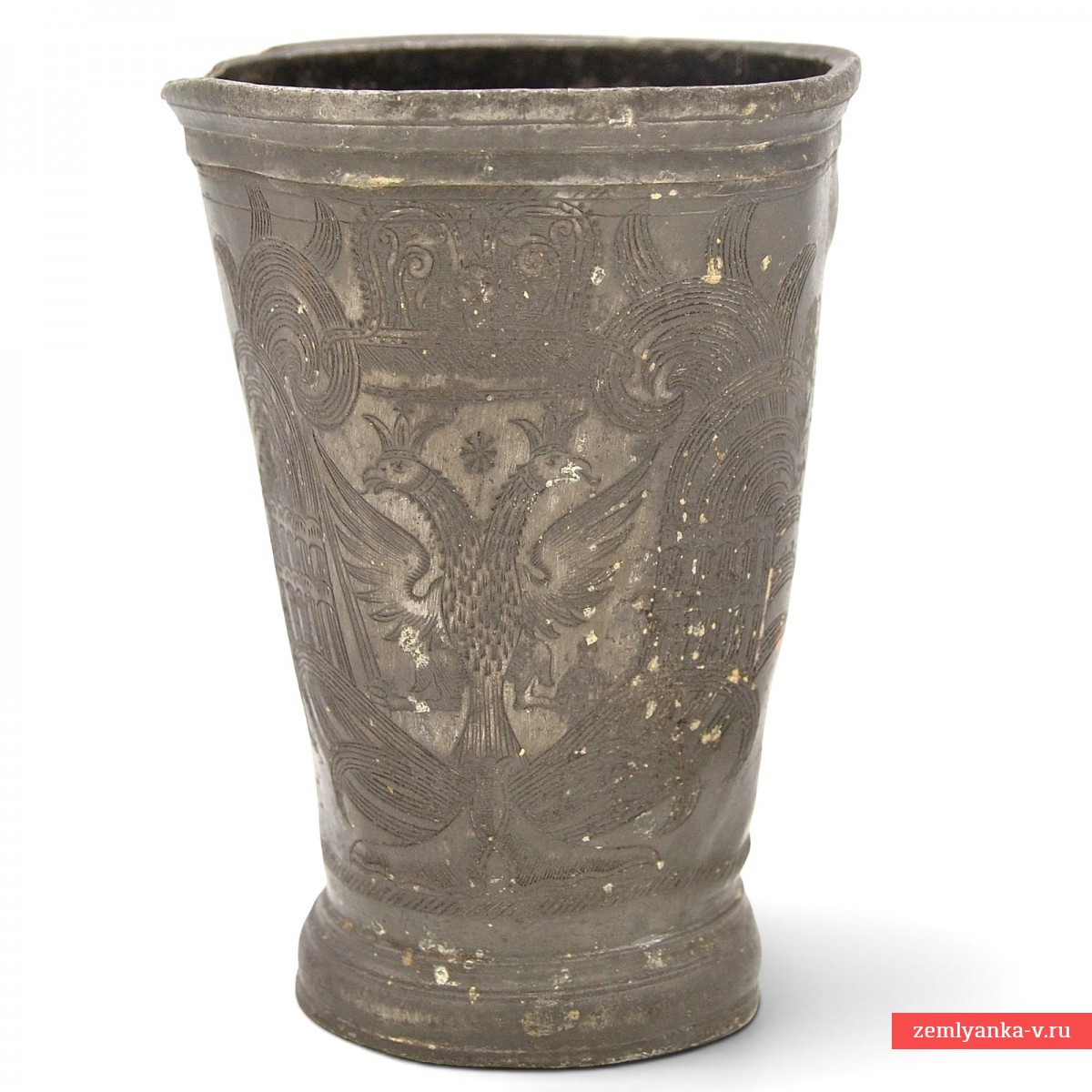
A uniquely rare massive glass made especially for the ceremony of presenting the title of "emperor" in 1721. Tin, engraving. On the body of the glass, on one side, there is an image of a Russian double-headed eagle; on the other, there is an inscription "vivat, vivat, vivat, vivat, vivat, vivat, vivat, vivat, vivat, vivat, vivat, vivat, vivat, vivat, vivat, vivat, vivat, vivat, vivat, vivat, vivat, vivat, vivat, vivat, vivat, vivat, vivat, vivat, vivat, vivat, vivat, vivat, vivat, vivat, vivat." Height 150 mm, mouth diameter 110 mm. Guarantee of authenticity.
At the beginning of the 18th century, the idea of the state was personified in the person of the monarch, that is, the political nomination of the country was determined by the title of sovereign. It was one of the features of the mentality of that era. Therefore, there was no special declaration of Russia as an empire — the new name of the state followed from the change in the titulature of Peter the Great and his place in the hierarchy of rulers.
Two months before that date, Russia had victoriously ended the Northern War. The peace concluded in Nystad not only put an end to the military rivalry with Sweden, but also defined a new form and significance of the Russian monarchy in Europe. The key event in the months-long grand celebration of the Peace of Nishtadt was the solemn service at the Holy Trinity Cathedral in St. Petersburg. Senior military and civilian officials gathered in the new capital from all over the country to participate in it, units of the 27th regiments of the victorious army arrived, 125 galleys of the Russian Baltic Fleet approached the Neva River near Troitskaya Square.
The reason for the actions of the secular and ecclesiastical authorities was not any new state of the state and society, but Peter's personal merits, his "great deeds", the purpose of which was the glorification of the All-Russian state, the "benefit" of all loyal subjects, the "strong and good state" of the state, "eternal peace with the crown of Sweden." The initiators of the presentation of the imperial title, the Senate and the Synod, acted, as it was announced, on behalf of "the common person of all loyal subjects," that is, the source of the imperial title of tsar was recognized by the will of the people.
After the liturgy, the reading of the instrument of ratification of the peace and the sermon, the ceremony of declaring Tsar Peter emperor took place. This act publicly recorded the overall outcome of the Northern War — Russia's new real military and political weight in Europe. The event that took place on November 2, 1721, led to a change in the title of the Russian monarch, state symbols, coronation ceremonies, mourning and other celebrations. The phrase "the great sovereign, the tsar of all Great and Small and White Russia, the autocrat" was changed to "We, Peter the Great, the emperor and the autocrat of All Russia." The royal crown above the double-headed eagle was replaced by the imperial crown.
As for Peter I himself, he believed that the Russian monarch was the caesar and successor of the Byzantine emperors since the time of Kievan Rus. Perhaps this was the reason for Peter's objections to the presentation of a new title to him, as well as the desire of contemporaries of the event to emphasize that the imperial title was not something new for Russia.
Thanks for your feedback!
Your feedback will be published after administrator check.
Be attended, we will not show the feedbacks, which:
Please note that by posting a feedback you take some responsibility to the readers.