Sold
| |
| Marking: | 70679 |
| Country: | Russian Empire |
| Dating: | One thousand nine hundred eleven |
| The original. | |
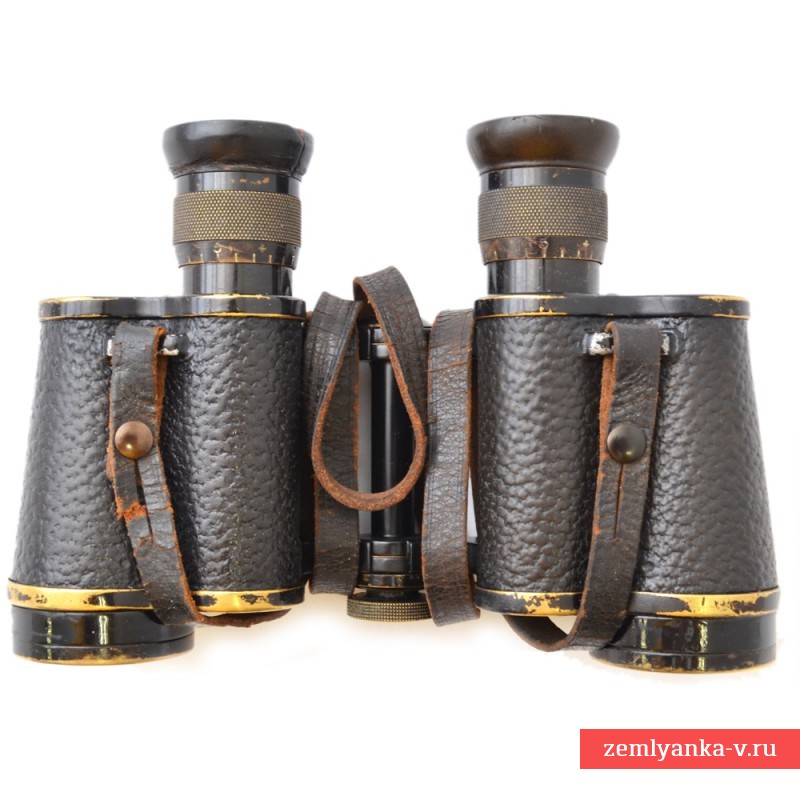
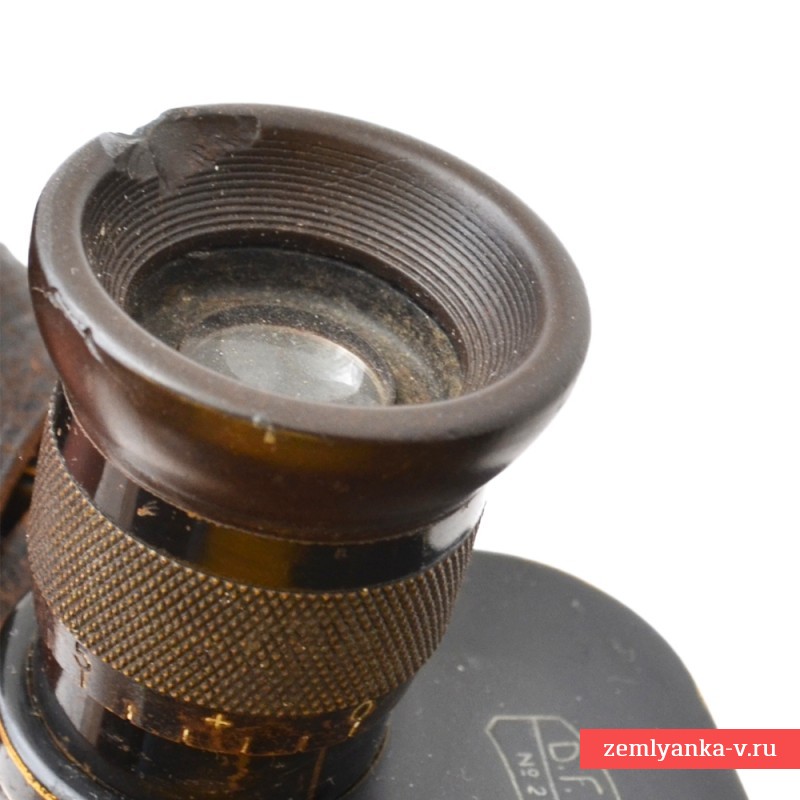
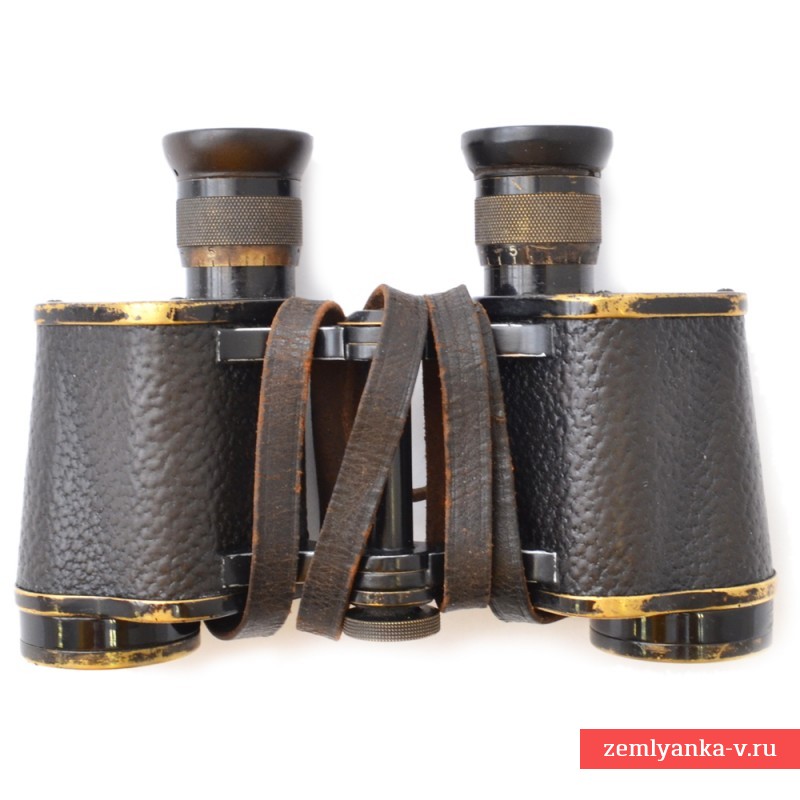
Prismatic military binoculars by the German firm K. Zeiss with a separate focus, made in Jena for the Russian Imperial army. In this modification were made in the period from 1911 to 1913, According to the classification adopted in tsarist Russia, belongs to the category of night or marine binoculars. Binoculars without angular grid, i.e., intended for officers of the infantry or engineering parts. Magnification binoculars — 6x, objective lens diameter — 30mm, exit pupil — 5mm. the System prisms — Porro-1. Binoculars consist of two telescopes (monoculars), connected by a hinge. To fix the binoculars in the selected position in accordance with the interpupillary distance of the observer's eye at the hinge pin has a special locking mechanism. The body of the monocular is made of silumin, covered with artificial leather of black color (to avoid shrinkage, characterized by using a coating of leather). Eyeglasses lenses made of aluminum alloy, outside covered with decorative thin-walled brass bushings with threaded clamping rings. For alignment of the binoculars in each of the lenses has a special design of the eccentric ring and eccentric frames lenses lenses. Brass also made the covers for the eyepieces, eyepiece sleeve and other metal parts of the binoculars, with the exception of the axis of the hinge and leaf springs for fixing the prisms, made of steel. All external parts are brass binoculars black painted (primer and subsequent paint)
On the housing side of eyepiece:
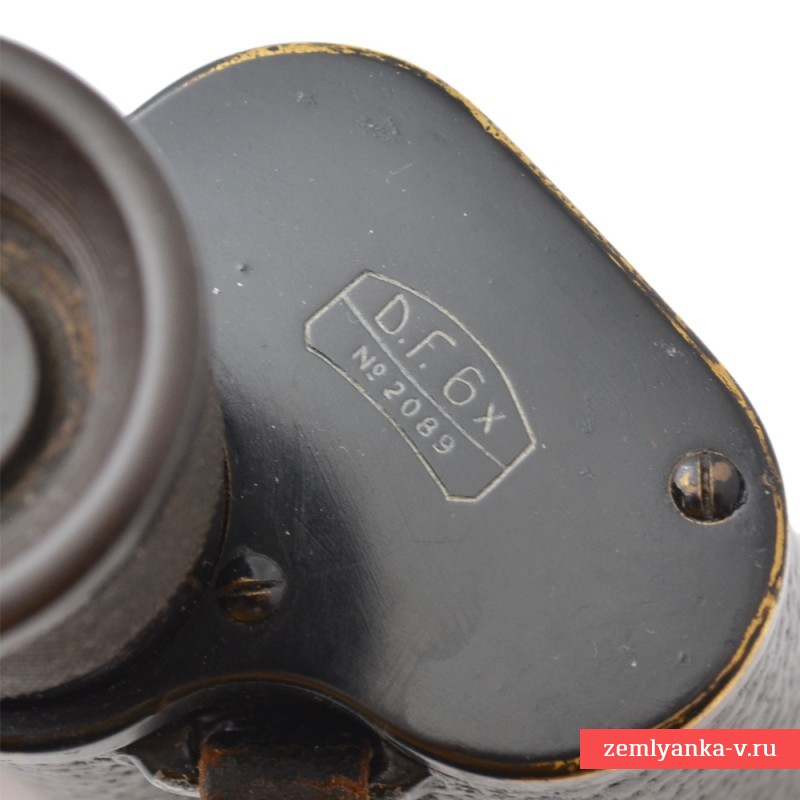
Right cover: inside the brand logo of the Zeiss in the form of achromatic lens : D. F. 6x ( symbol of military binoculars and zoom); No. 2089 - room binoculars on the specific contract concluded between the manufacturer and the Russian military Department.
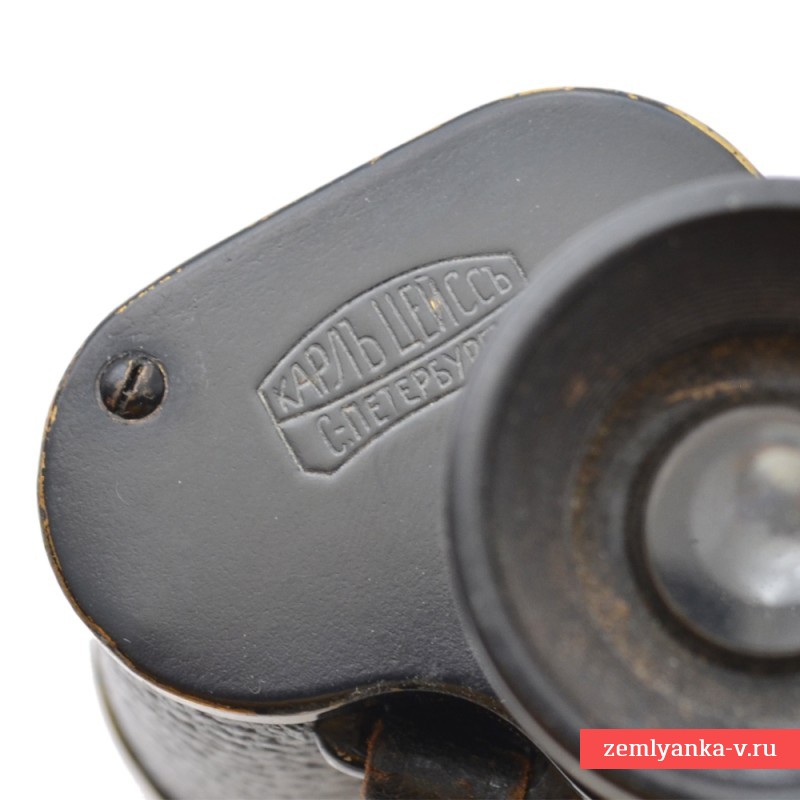
Left cover: inside the brand logo of the Zeiss in the form of achromatic lens - "Carly Zeiss / S.-Petersburg".
The company's founder, Carl Friedrich Zeiss was born on 11 September 1816 in Weimar, in the family court Turner-cabinetry. In 1832 the young Carl Zeiss moved to Jena, where in the period from 1834 to 1838, trained as an apprentice at the famous optics-mechanics Friedrich Kerner. In may 1846, Carl Zeiss submits to the authorities a petition in which he asks permission to open a workshop for making optical instruments and 17 November of the same year opened its "mechanical Atelier". Zeiss is trying to attract to the production of talented and extraordinary people , one of whom was a privatdozent, University of Jena Ernst Karl Abbe (1840 -1905) became a true discovery for the firm. Carl Zeiss offers him cooperation and Abbe became a freelance employee of the company.
Thanks to Abbe, the firm soon began producing microscopes that provide unprecedented image quality. But is the quality still does not satisfy K. E. Zeiss and Abbe, who understands that further progress depends mainly on the quality of the applied optical glasses . In 1884 E. Abbe met with chemist Dr. SCHOTT Friedrich Otto (1851 - 1935) of the Witten conducting at the time of the research in the field of chemical composition of glass. As a result of this experience they created a technological laboratory glass "Schott & Genossen Glass Works of Jena" , the founders of which be SCHOTT, Ernst Abbe, Carl Zeiss and Zeiss Roderich. In 1891, the son Roderich Zeiss Zeiss out of business. The company merged with the glass factories of Otto SCHOTT and Abbe becomes the head of the company Carl-Zeiss-Stiftung until his death in 1905.
In 1894 the firm "Carl Zeiss" is coming out with a completely new type of binocular, in which the inversion system uses a system of prisms, invented in 1850 by an Italian engineer-surveyor, Ignazio Porro (1795-1875) . Due to the poor quality of optical glass Porro then failed to implement their development and only forty-three years later, the successes achieved by the firm Schott in the technology of glass, was allowed to return to the old idea. Foundation "Carl Zeiss" tried to patent the scheme of prism image erecting system, but the patent application was granted only in respect of the design of binoculars with increased distance biobjective (patent No. 77086 July 9, 1893 ). The patent was in force until 1908, allowing only firm "Carl Zeiss Jena" in this period had exclusive right to manufacture binoculars with increased distance biobjective.
The development of the firm continued - in 1901 opened a sales branch in London, then in Vienna, in St. Petersburg, in Paris and Tokyo, in 1914 in Buenos Aires.
A powerful impetus for the start of the close cooperation of the company "Carl Zeiss" and the military departments of Russia was the Russian - Japanese war 1904 - 1905 the experience of the application of optical instruments of different companies during the war showed the inherent advantage of optical instruments company Carl Zeiss on the products. So in the opinion of Colonel Delvig noted by the Artkom GAU in March, 1906, said: "widespread in the army had binoculars Zeiss 8 × zoom (military sample); these binoculars worked well." Binoculars Zeiss this increase surpassed the binoculars Hertz 9 -fold increase". The question here was about the Zeiss binoculars "R. V." Model - "Russian military model". In 1908 - 1909 the firm made GAU a few completely new models military prism binoculars with excellent optical characteristics and enables them, thanks to the achieved tightness, glass goniometric grid. Especially liked the Russian military prism binocular 6х30. Since 1910 all the graduates of the infantry, engineer and cavalry schools in accordance with the order of the VV number 1-1909 the city began to receive after graduation at public expense only binoculars 6х30. These binoculars had a distinguishing mark — the crossed rifles on the ocular caps.Binoculars purchased various Russian military departments and directly to military units. Since 1914 binoculars 6х30, but with a goniometric grid, began to and graduates of the artillery school. Binoculars 6х30, thus, gradually became a single model field binocular for the Russian Imperial army. The last order for binoculars 6х30 directly to the firm C. Zeiss were taken with a Warehouse of instruments and benefits under the Officers ' infantry school in Oranienbaum in July 1914, but nevertheless its obligations under this contract during 1915, the firm Zeiss performed.
Thanks for your feedback!
Your feedback will be published after administrator check.
Be attended, we will not show the feedbacks, which:
Please note that by posting a feedback you take some responsibility to the readers.