24 375 $
| |
| Marking: | 96566 |
| Country: | Russian Empire |
| Dating: | 1862 year |
| The original. |
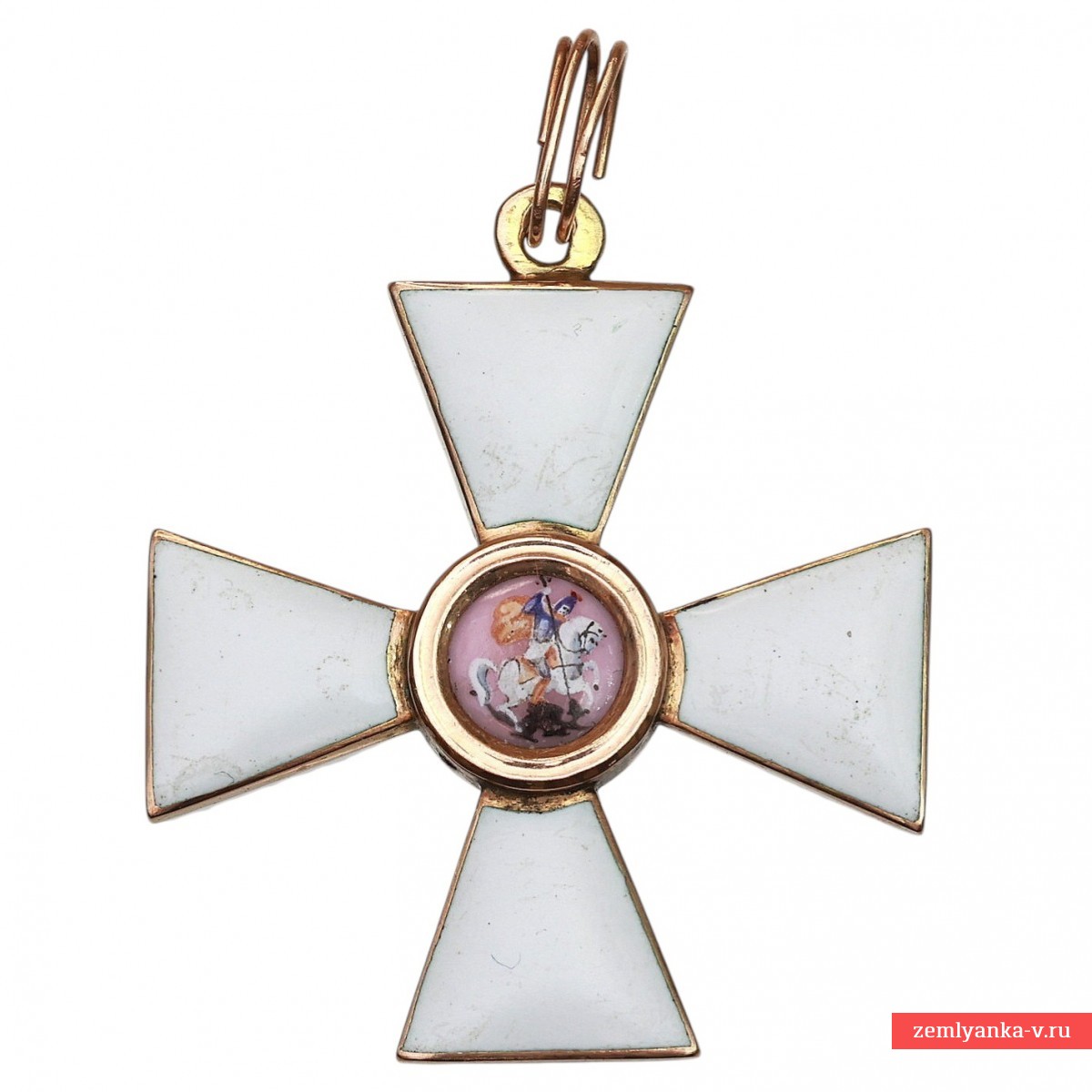
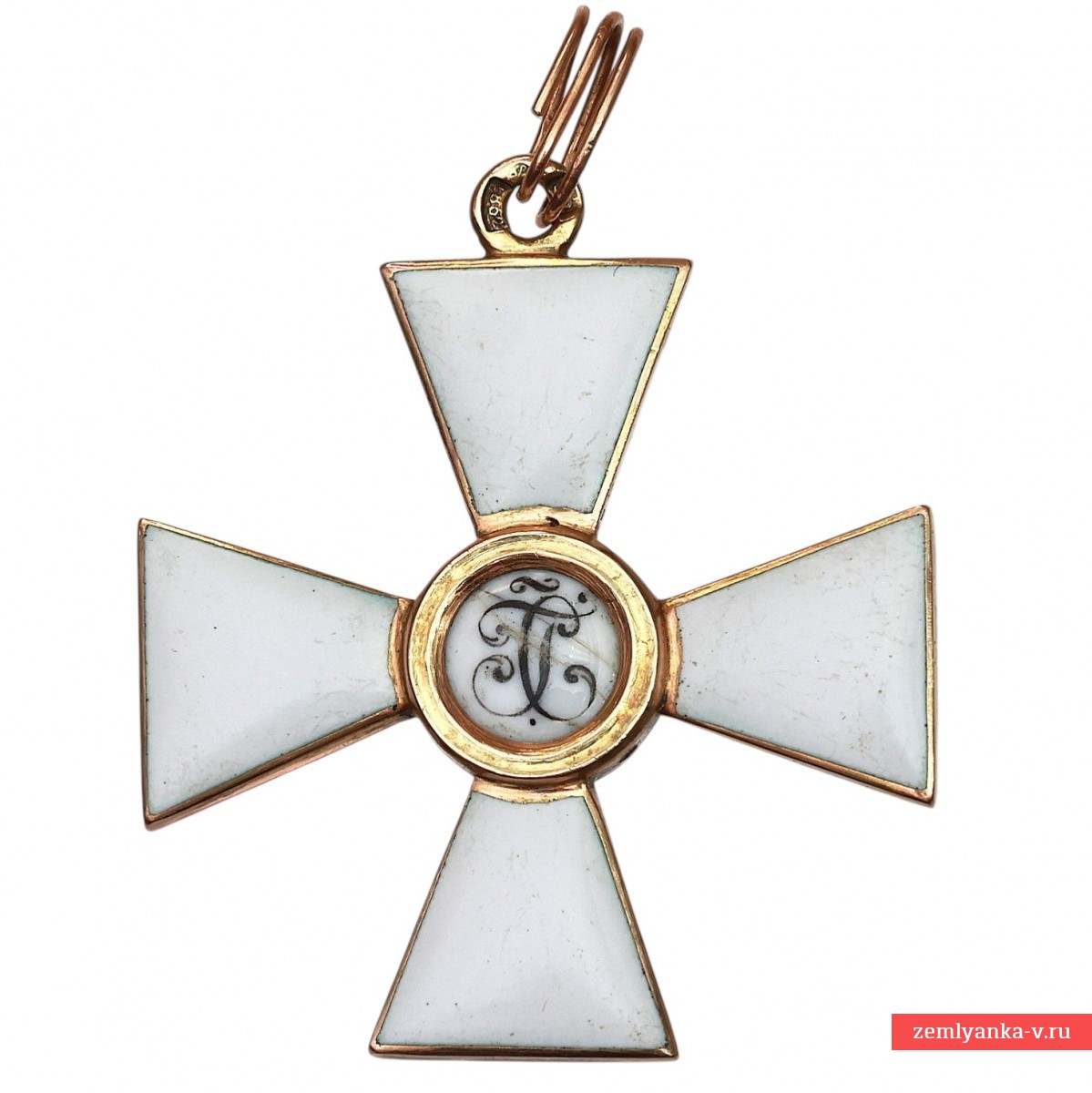
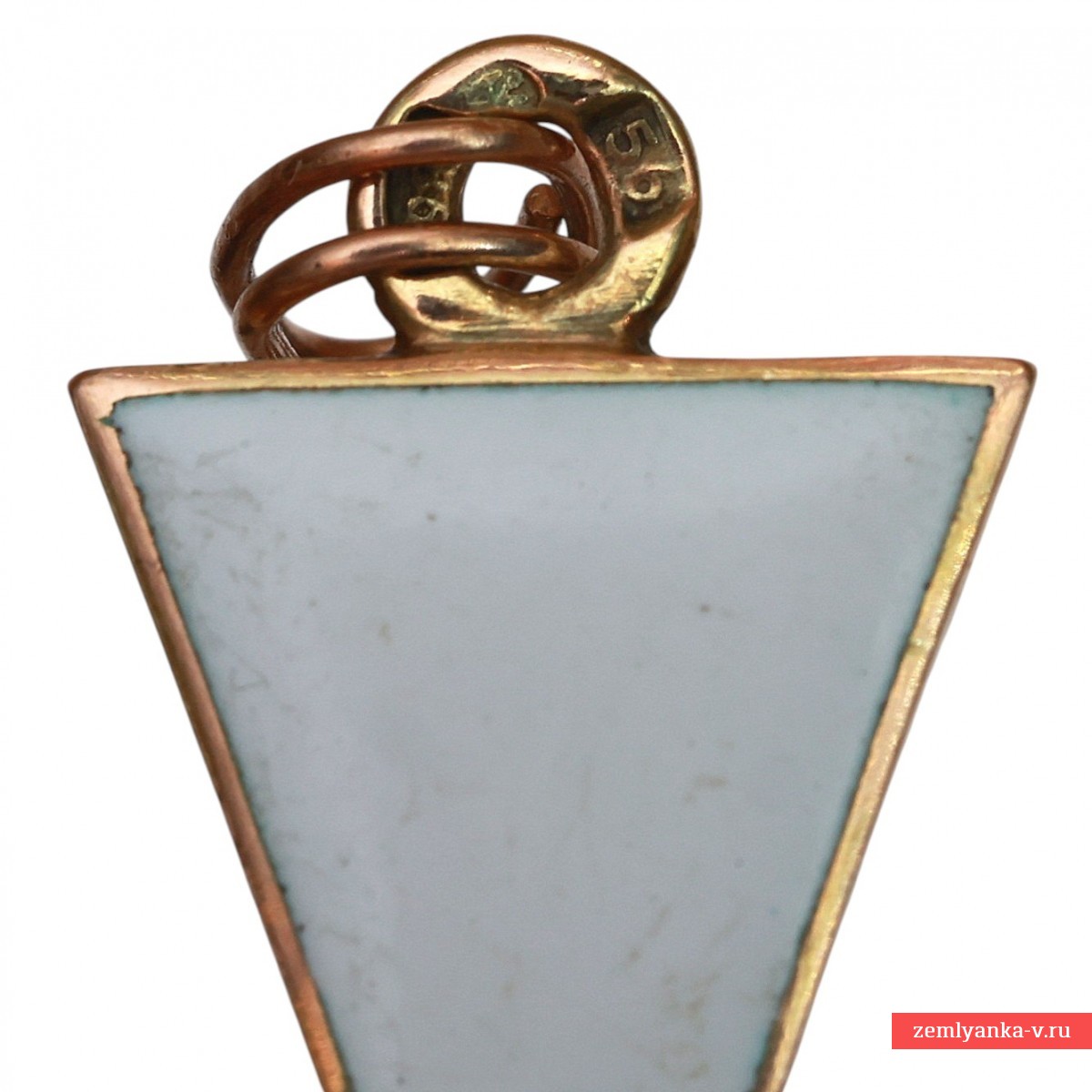
56 gold, enamel, stamping. The sign is an equi-pointed cross with an eye on the upper ray and flaring ends, on the front side of which the monogram "SG" ("Saint George") is placed in the center of the medallion. In the center of the reverse is a round medallion with a relief image of a horseman piercing a snake with a spear (St. George). There is a 56-gold stamp on the ear, dated 1862. Weight 10.63 g. The size is 38*42 mm. The manufacturer, Keibel, was the official supplier of the Chapter House from 1836 to 1905. From 1836 to 1862 (until 1854, together with Heinrich Wilhelm Kemmerer), Johann Wilhelm Keibel (1788-1862) owned it. After I.V. Keibel's death, his son, Julius Keibel (1852-1882), became the supplier, and in 1882-1905 he was I.V. Keibel's grandson, Albert Keibel (1854-1910). Good preservation, threadlike cracks on the medallion. The original industrial link is included. Guarantee of authenticity.
The Imperial Military Order of St. George the Great Martyr and Victorious (Order of St. George) is the highest military award of the Russian Empire. In an expanded sense, it is an all—encompassing set of distinctions of officers, lower ranks and military units. It was established by Empress Catherine II on November 26 (December 7), 1769 in honor of St. George to distinguish officers for services on the battlefield and service in military ranks. He had four degrees of distinction. More than 10,000 people have been awarded the Order, the first, highest degree of the order — a total of 23 people, of whom only four became holders of all four degrees. There were also two awards of the Order of the 1st degree: by Empress Catherine II on the occasion of the establishment of the order and by Emperor Alexander II on the occasion of the celebration of the 100th anniversary of the order. 125 people were awarded the second degree of the Order. The first recipient of the order, apart from Catherine II, was in December 1769, Lieutenant Colonel Fyodor Ivanovich Fabrizian, who was awarded the 3rd degree at once, bypassing the lowest.
In 1833, the statute of the order was changed and painted in detail, with a detailed description of the military virtues for each branch of the armed forces, for which they were entitled to be awarded. The length of service required for service awards was described in more detail, and the requirement to participate in at least one battle was added to receive the George 4th degree for service. A strictly consistent order of awarding was established, from the 4th to the 3rd degree (however, later exceptions were made to this rule. Thus, General M. G. Chernyaev was immediately awarded the 3rd degree of the Order for the Central Asian campaigns, bypassing the 4th, and Admiral P. S. Nakhimov was awarded the 2nd degree after the 4th for the victory in the Battle of Sinop, bypassing the 3rd.) Articles for the soldier's "Insignia of the military Order" were included in the statute.".
Since St. George is a Christian saint, a variant of the order was provided for the Gentiles, in which the coat of arms of Russia, a double-headed eagle, was depicted instead of St. George. The model of the order with the eagle was approved by Nicholas I on August 29, 1844 during the Caucasian War, and Major Jamov-bek Kaitagsky was the first to receive the new badge. In this regard, there are moments in memoirs and fiction when officers from the Caucasus wondered: "why was I given a cross with a bird and not a horseman?" Since 1845, awarded only the Orders of St. Nicholas. Vladimir and St. George of any degree received the rights of hereditary nobility, while other orders required the award of the highest — 1st degree. Before that, any order (with the exception of the Polish-Russian Virtuti Militari Order) gave the right to hereditary nobility.
From 1849 to 1885, the names of St. George's cavaliers were inscribed in gold on marble plaques in the St. George's Hall of the Grand Kremlin Palace in Moscow.
In February 1855, a decree was issued according to which the cavaliers of the Order of the 4th degree for service, who distinguished themselves in battle and deserved to be awarded the cross of the 4th degree, had the right to add to the Badge of the Order of St. George of the 4th degree, which they had previously received for service, a bow from the St. George ribbon, which would indicate that the wearer He was awarded this award twice: for long service and for military feat. It was ordered to name such cavaliers "Cavaliers of the Military Order of St. George, 4th degree, for 25 years (or 18 and 20 naval campaigns) with a bow." However, this distinction has not taken root in the Russian award system, only 5 knights of the Order of St. George with a bow are known.
In 1913, the statute of the order was changed again, mostly additional articles were included in it and the description of military exploits by branch of the armed forces was expanded. The "Insignia of the Military Order" acquired the official name of the St. George Cross. Cavaliers of the 4th degree of the Order had their length of service reduced to a minimum for promotion to the next rank, from one year in junior officer ranks to four years from major generals to lieutenant generals. The benefits for St. George cavaliers have been expanded: preferential travel "along the communication routes", two-month annual leave with maintenance, etc.
On June 29, 1917, the Order of St. George, 4th degree, became the only order in Russia that soldiers could be awarded (if they performed officer duties in combat). The ribbon of such an order was decorated with a silver laurel branch. It is known about two winners of such an award, one of them is the art. firecracker I. E. Firsov.
Thanks for your feedback!
Your feedback will be published after administrator check.
Be attended, we will not show the feedbacks, which:
Please note that by posting a feedback you take some responsibility to the readers.