1 874 $
| |
| Marking: | 96706 |
| Country: | Russian Empire |
| Dating: | 1812 year |
| The original. |
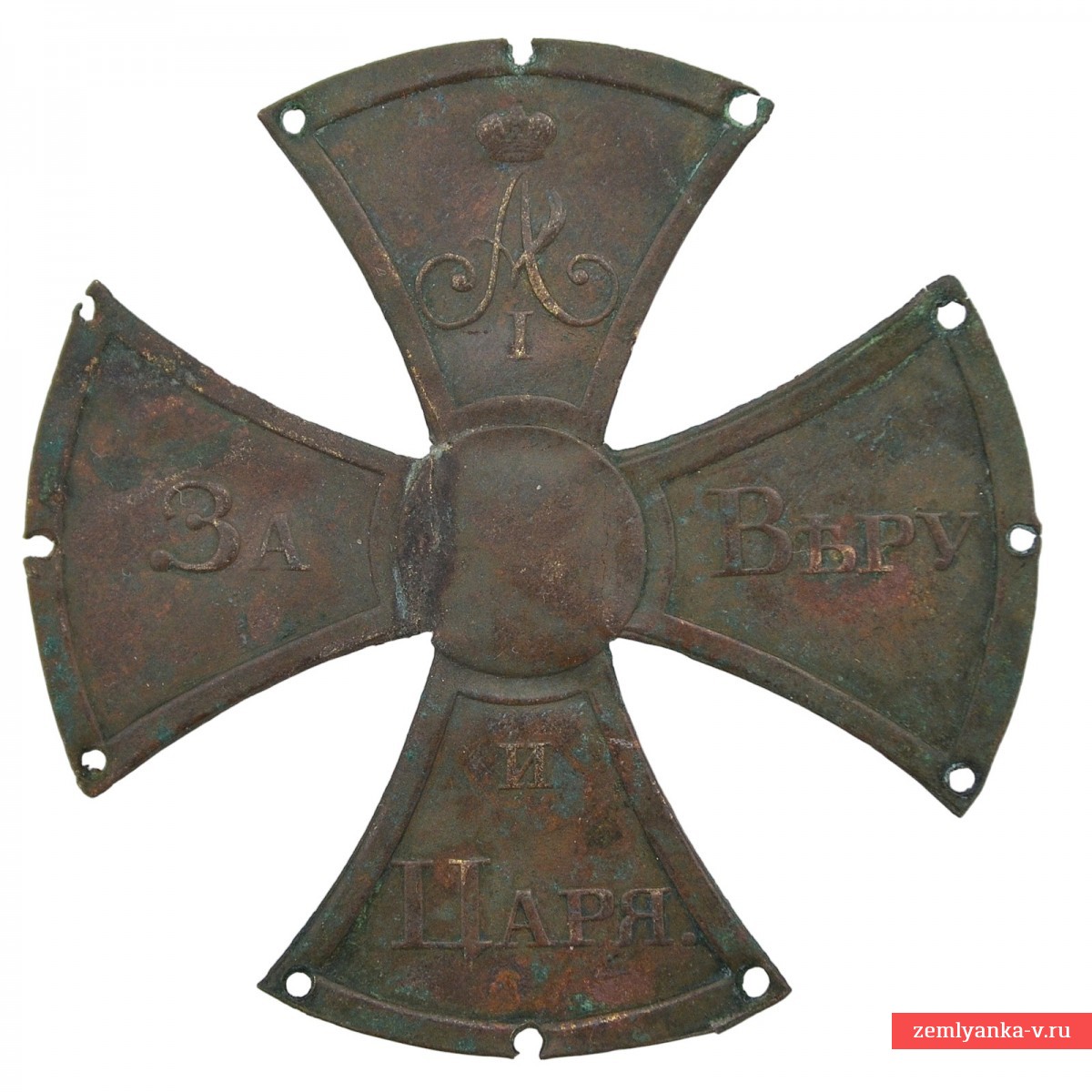
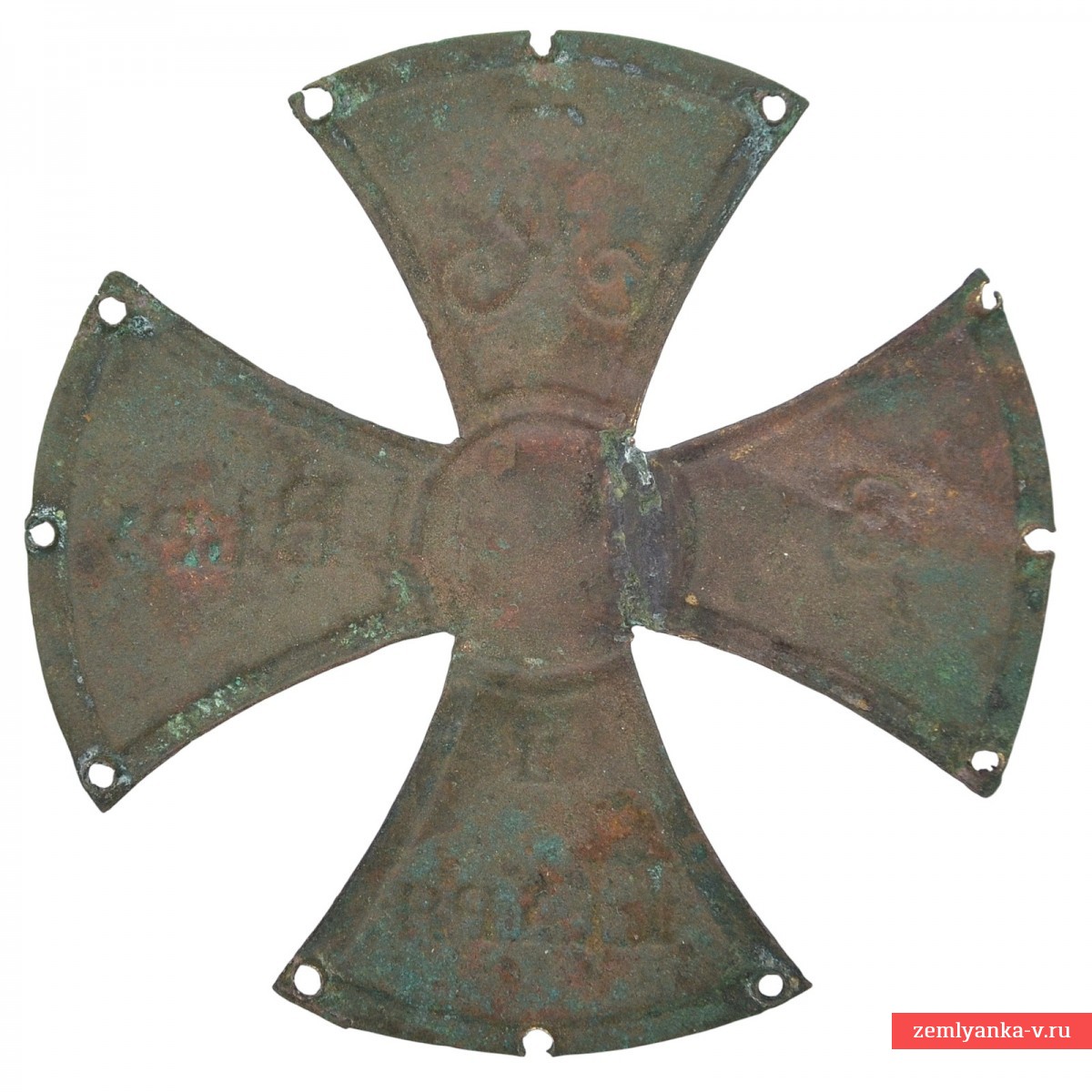
An extremely rare cockade is a real collector's dream. Brass, stamping. St. Petersburg Mint. It was also used as an award ("By order of the corps commander, General of cavalry Count Wittgenstein, twenty-two crosses of the St. Petersburg militia with the name of the Emperor and the inscription were given as a badge of distinction for zeal and zeal for the benefit of the fatherland: for tsar and faith to the peasants of the village of Zhartsy, who fought several times by themselves against the French, defending property my own, trying solely to eradicate the enemy who was harming the fatherland; they are allowed to wear these crosses forever on their hats, in assurance of which this certificate is given under my signature with the seal of His Excellency on October 11, 1812. To His Imperial Majesty, my Most gracious Sovereign, Privy Counsellor, chief of the St. Petersburg and Novgorod militia, Senator and Cavalier Bibikov. The essay "The award medal of the participant of the Patriotic War of 1812 as a monument of the epoch."). Currently, no more than a dozen surviving copies are known. The preservation is very good, there are traces of repair of the left beam. The size is 67*67 mm. Guarantee of authenticity.
By decree of July 31, 1812, Alexander I created a Special Committee "in his presence." The chairman of the Department of Military Affairs of the State Council, A.A. Arakcheev, who joined this committee, the Minister of Police, A.D. Balashov, and the Secretary of State, A.S. Shishkov, even before their official appointment, together with the Moscow Commander-in-Chief, F.V. Rostopchin, on behalf of the emperor, developed and submitted to him for approval on July 14 a regulation on the Moscow militia, called "The composition of the military Moscow forces", which was the basis that determined those general principles established by the central government, based on which it was possible in the provinces, in accordance with local conditions, to take their own initiative.
About militia badges, this document stated that militia members should have a cross embossed from copper brass on their caps and at the bottom of it the monogram (i.e. monogram. – V.B.) of His Imperial Majesty's Name as a sign: for Faith and the Tsar. According to the literal meaning of this phrase, the cross and the imperial monogram should have been placed separately on the militia's headdress, but its fundamental, defining meaning was, of course, not in this, but in the fact that it set the theme, the content of the militia signs – they were supposed to express the motto "For Faith and the Tsar," and in which It was the form of this that would be implemented – in the form of a separately made cross and monogram, or in the form of placing the motto itself on the rim of the cap, or in any other way - that the provinces could decide on their own. This is exactly how it was understood locally, as evidenced by the presence of variants of militia signs of 1812.
For many decades, both in general historical and in special numismatic literature, the statement has been wandering from one publication to another that in 1812 there was a unified militia badge and this badge was a brass cross minted at the St. Petersburg Mint, on the widened ends of which, having holes at the edges for sewing to the headdress, are placed there were: at the top – the monogram of Alexander 1 under the crown, and on the sides and below the inscription – "For–Faith – and–the-Tsar."
In the last decades of the nineteenth and early twentieth centuries, this sign even became one of the main symbols embodying the Patriotic War of 1812: its image was placed on medals in memory of the consecration of the Cathedral of Christ the Savior in Moscow, reproduced on the covers and titles of books and pamphlets, especially those published for the centennial anniversary of the epic of 1812, and the statement of the authoritative "According to the Military Encyclopedia, "during the Patriotic War, "the cap of each militia member was decorated with a copper cross with the inscription: "For Faith and the Tsar" ...", in one form or another, varied in a wide variety of publications.
Thanks for your feedback!
Your feedback will be published after administrator check.
Be attended, we will not show the feedbacks, which:
Please note that by posting a feedback you take some responsibility to the readers.