275 $
| |
| Marking: | 72583 |
| Country: | Germany |
| Dating: | 1930s |
| The original. |
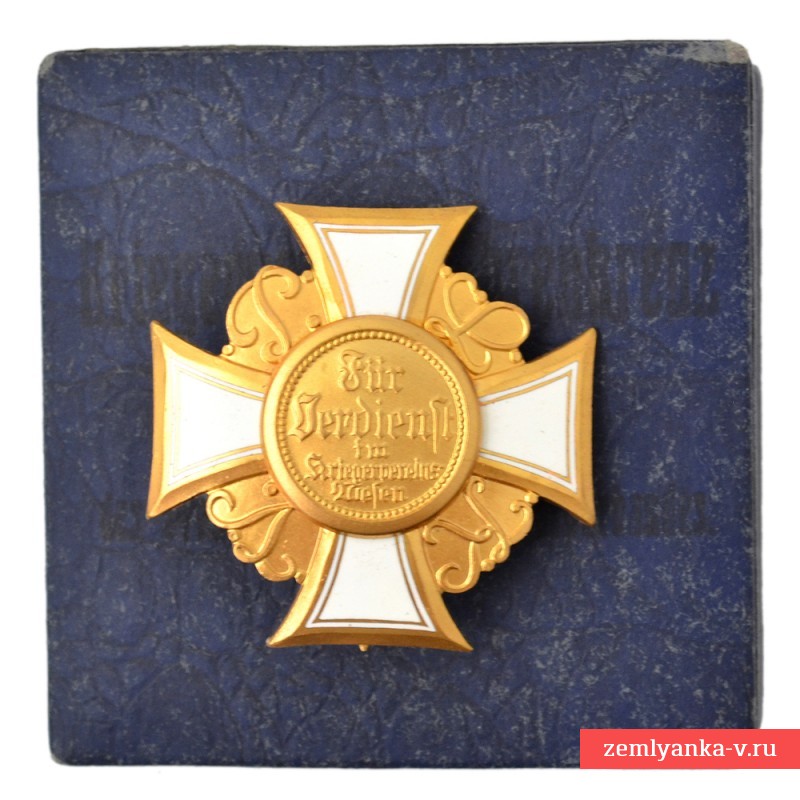
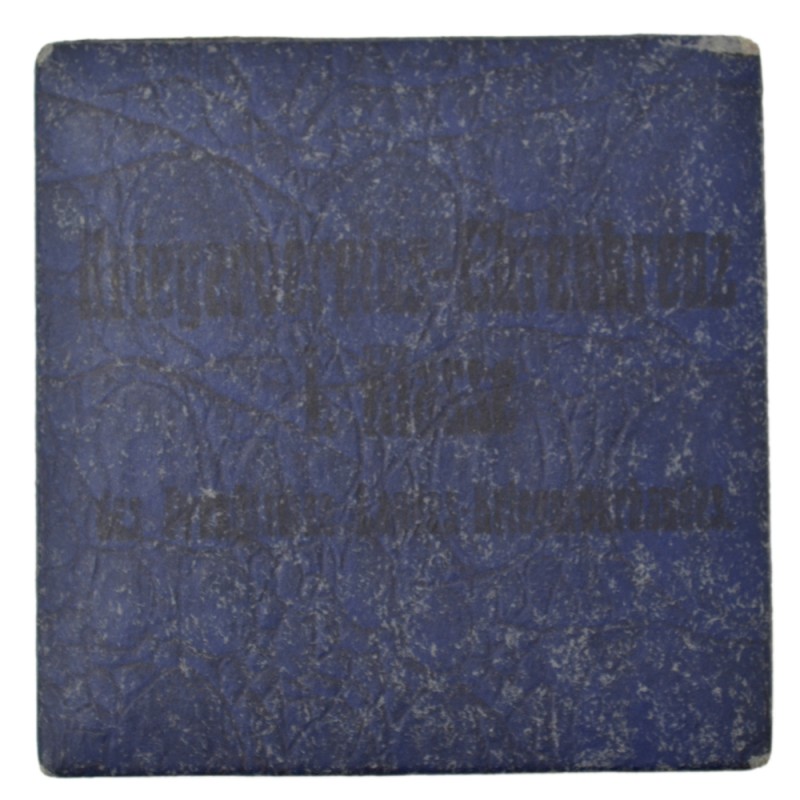
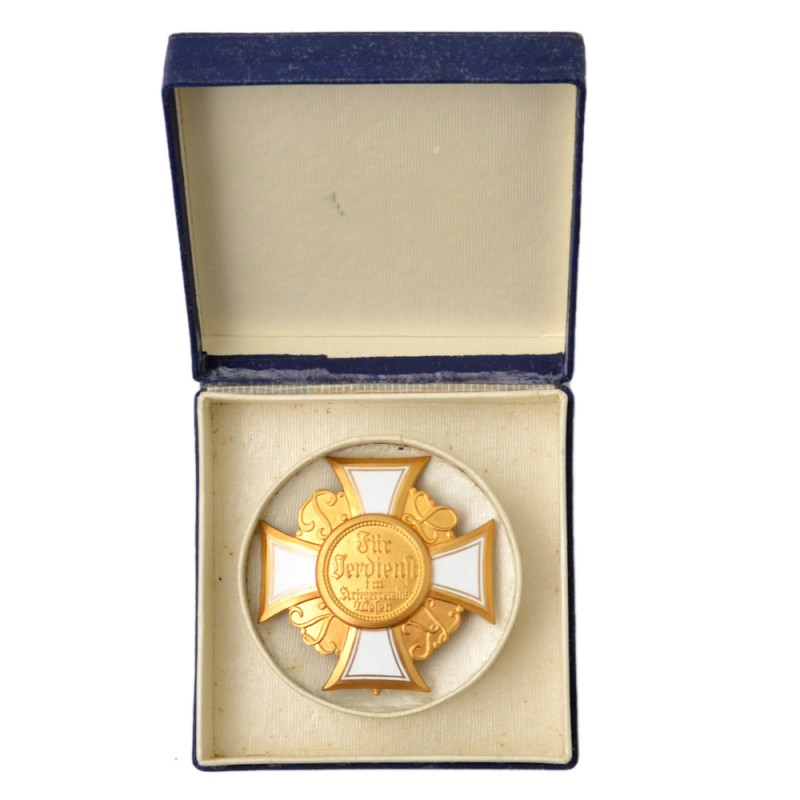
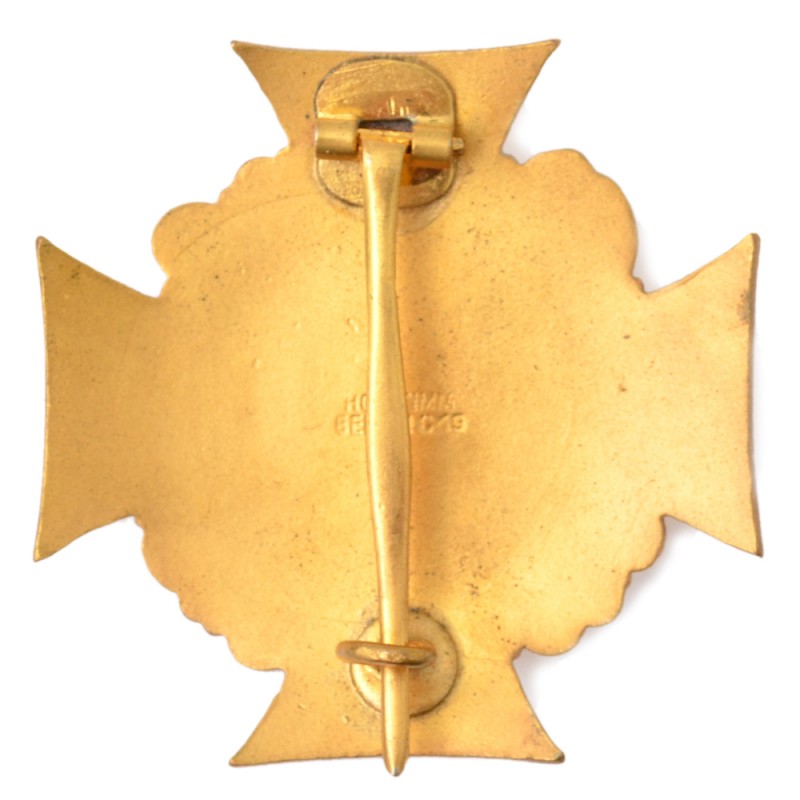
A rare sign in very good collectible condition. Bronze, enamel, gilding. In the original case. The award is made in the shape of an equilateral Teutonic cross with a high and wide collar. At the centre of the obverse, superimposed round medallions with a wide rim diameter of 22 mm. inside On the obverse of the medallion is an inscription, done in Gothic letters, in five lines: "For merit in the activities of the veterans 'Association" ( "Für / Verdienst / im / Kriegervereins / a's Wesen"). Between the rays of the cross there is a small plate, on the obverse, each of whom has the same ornate swirling uppercase letter: P, L, K and V, together forming the acronym of the Union, "P.L.K.V.". Each letter is surrounded by three raised dots, except "K" (two). The reverse is smooth. Fastening to a clothes pin. The guarantee of authenticity.
Cross of honour of the Prussian land of Union veterans was established in 1921, the leadership of the organization in two classes. Cross 2nd class awarded by the decision of the Berlin Board of the Union (Landesvorstand des Preußischen Landes-Krieger-Verbandes) at the written request of individual veterans ' associations (Kriegervereine) for active participation in the activities of the Association, and 1st class for special merit in the work. To obtain cross 1st class had to be the gentleman of awards of the 2nd class, but in exceptional cases, the management decision could simultaneously be awarded the crosses of both classes.
It is worth noting this interesting feature of awarding the Honorary crosses the dependence of the quantity of signs of the strength of a particular structural unit of the Prussian land Union. So, I was allowed to award crosses of the 2nd class not more than 10% of veterans from each local branch of the Union, i.e. ten people, only one could be the holder of the award. Even more stringent were the rules for the issuance of the honour cross 1st class: only one sign per hundred veterans.
Cross of honour of the Prussian land Union veterans were made of bronze. The surface of the cross 1st class of size 45x45 mm was plated, 2nd class size 44,2х44,2 mm – silver plated. Issued as 16 mm miniature awards, as the long needle, and with an eye to wear on a chain.
The signs were manufactured by the Berlin firm of Heinrich Timm (Erster Berliner Abzeichen - und Fahnenfabrik Heinrich Timm), founded in 1846 and located in the described period at: Berlin C19, Wallstraβe 23-24. The mark of the manufacturer made in capital letters – “H. Timm Berlin C.” – was present at the round lug, located above the upper beam of the cross.
Initially cross 1st class was worn on a neck ribbon, while the 2nd class on the left breast the ribbon of the Prussian colors, consisting of alternating black and white horizontal stripes with narrow white stripes on the edges. There are copies designed to be worn on the bow. Persons awarded the Honorary cross of Prussian land Union veterans of both classes, wore them at the same time.
Marks awarded along with the award certificate (Besitz-Zegnis) with the signature or a facsimile of the Prussian President of the land Union veterans. After the great war to the coming to power of the national socialists, this position was occupied by General-Oberst Jozias von Heeringen (Josias von Heeringen, 09.03.1850-09.10.1926), and after his death – General der artillery retired Rudolf von horn (Rudolf von Horn, 09.07.1866-04.02.1934). By the way, according to tradition, the President of the Prussian land Union veterans also held the position of Chairman of the Union of the Kyffhäuser (Kyffhäuserbund). Some certificates were signed by other senior executives of the Union, in particular, “the third President”,i.e. one of the Vice-President, General retired major Paul Gobbino (Paul Gobbin, 1864-1935).
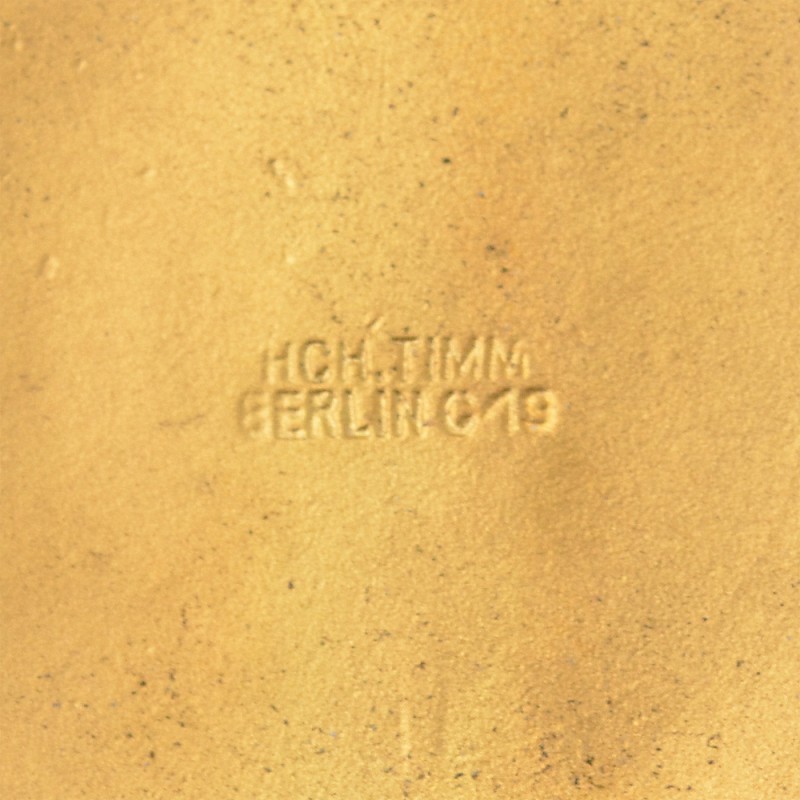
Honorary cross of the 1st class of the Prussian land Union of veterans of a sample of 1921 was given until 1925, while him a change came a cross a new design, established 01.08.1925 g. Outwardly, he is fully repeating the obverse of the crosses of a sample of 1921, however, there are several differences. So, the rays of the cross covered with white enamel, and closer to the edge was located a thin Golden border. The cross itself was slightly convex shape with a smooth reverse side. The maker's mark was located in the center of the reverse in two lines: “Hch. Timm / Berlin C19”. Unlike its predecessor, the cross of the 1st class. 1925, were worn on the neck ribbon, and fastened with a vertical needle and catching hook soldered to reverse. Were made it is still made of bronze with gilding the surface, weighed about 24 g, and the size was 44,2х44,2 g.
The veterans, awarded the cross 1st class of the sample of 1921, could exchange it for a sign of a new sample, paying 6 marks. Replacement procedure, however, was optional and allowed the wearing of crosses of the initial pattern.
In the catalog Joerg Nimmergut is a picture of the Honorable cross, which is a sign 1-St class of a sample of 1921 without the lug on the upper beam, but soldered to the reverse with vertical needle on the hinge and a catching hook.
The number of awards is unknown, but the Honorary cross of the 2nd class of the Prussian land of the Union of veterans was one of the most common post-war characters. On the number of knights can be judged on the basis of official data. So, in 1903, in Germany, there were 26 veterans, most of whom were Prussian: it consisted of 13,453 enterprises, which consisted of 1,167,187. In the circular of the Prussian war Ministry from 13.01.1910 G. said: “there has been a steady increase in the number of veterans ' associations (Kriegervereine), joining the ranks of the Land unions (Landesverbände). As 01.10.1909 in the Prussian land Union veterans, there were 16,533 enterprises total number 1,439,145 man.” These figures appear even more impressive if to take into account that in 1873 the German veterans Union (Deutscher Kriegerbund) was only about 27 thousand people, and by 1890 the Union consisted of “only” 400 thousand people.
It would seem logical to assume that even despite the natural downsizing of the Union after the First world war, he joined many ex-soldiers.
Thanks for your feedback!
Your feedback will be published after administrator check.
Be attended, we will not show the feedbacks, which:
Please note that by posting a feedback you take some responsibility to the readers.