
244 $
| |
| Marking: | 68072 |
| Country: | Germany |
| Dating: | 1914-1918 |
| The original. |
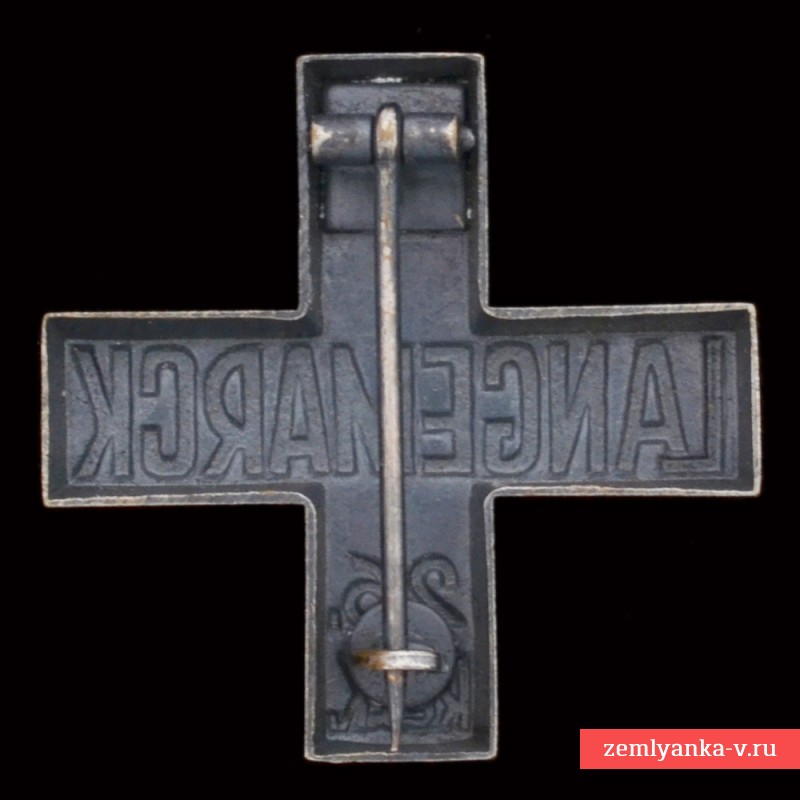
The original sign is in very good condition. Buntmetall, silver, tinted glass. The guarantee of authenticity.
On 22 April 1915 at the town of Ypres from the standpoint of the 26th reserve corps "Langemark" was made by the Germans chemical attack (chlorine), resulting in 5,000 dead. Historians believe that the so-called Second battle of Ypres, which began on 22 April 1915, the German side had a view not only to capture the city, but to test on the front new weapons. The high command of the Imperial troops chose, for the purposes of attack enemy positions in the southwestern part of the Ypres salient. The result of meteorological observations, the high command was convinced that the new weapon is best to test during the upcoming domination of southern winds; therefore, the experiment was made on the part of the front, turned to the North. It was the junction of the 2nd British army and 20th French corps.
On the front of the attack is 6 km was installed cylinder battery 20 gazoballonnogo each, for the filling of which took 180 tons of chlorine. It took just 6,000 bottles, of which half of the commercial sample was requisitioned. In addition to these were prepared 24 000 new cylinders is half of the volume. Of the total number of harvested stocks of chlorine in the battle was used by only 30%.
The German army led by Duke Albrecht of Württemberg has failed to develop initial success. The German command in March 1915, was preparing a major operation to break through the enemy front with the use of chemical weapons. The blow was delivered at the site of the junction of the 2nd British army and 20th French corps. Within a few days of the German chemical troops, the night has installed 150 photovoltaic panels. On April 22 at the position of the British troops there were 180 thousand kg of chlorine. Yellowish-green cloud moved on the enemy positions behind him in gauze bandages advancing German infantry. British soldiers, not being equipped with means of protection against gas, choked and fell dead. The British in panic abandoned their positions without a fight was the German soldiers. Chlorine is affected 15,000 people, 5,000 of whom died. Between the English and French troops created a gap in the 3.5 km Road to Ypres was free. However, not having the reserves the German command was unable to benefit from the situation. By car and on foot the British and French pulled reserves and occupied the gap in the defense, all subsequent attempts by German forces to break through the defense proved unsuccessful. The British and French were already equipped with the simplest means of protection against chemical weapons. In further fighting in may, the Germans managed to advance a short distance, but the main task of the breakthrough front and the capture of Ypres was not implemented. The first ever use of the gas, brought the Germans with limited success. But it was the beginning of the mass use of chemical warfare of the warring States. Develop remedies and new element of combat support — chemical defense troops. Already in 1915, simple gauze dressings were replaced by masks.
Thanks for your feedback!
Your feedback will be published after administrator check.
Be attended, we will not show the feedbacks, which:
Please note that by posting a feedback you take some responsibility to the readers.