11 875 $
| |
| Marking: | 96827 |
| Country: | France |
| Dating: | 1810 year |
| The original. |
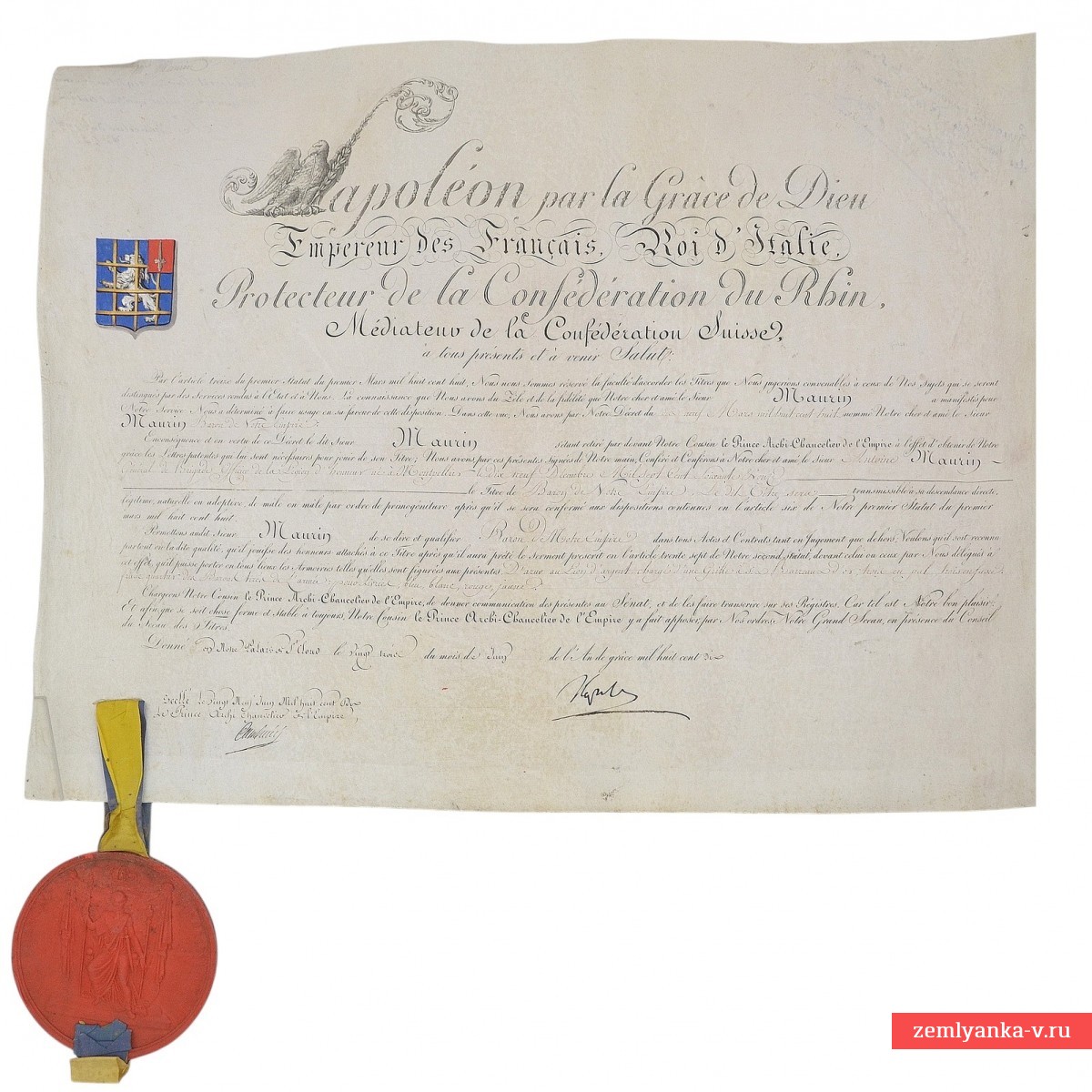
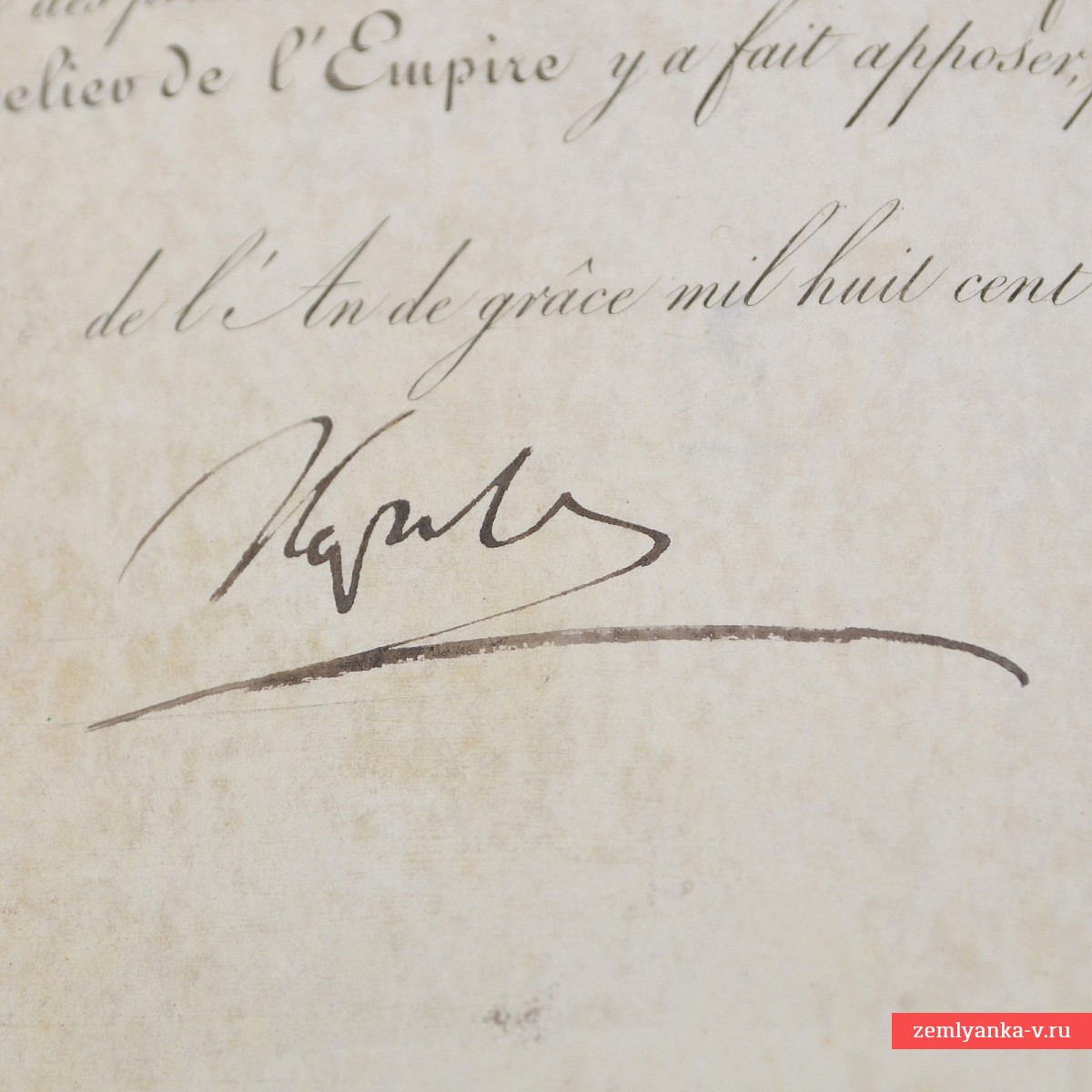
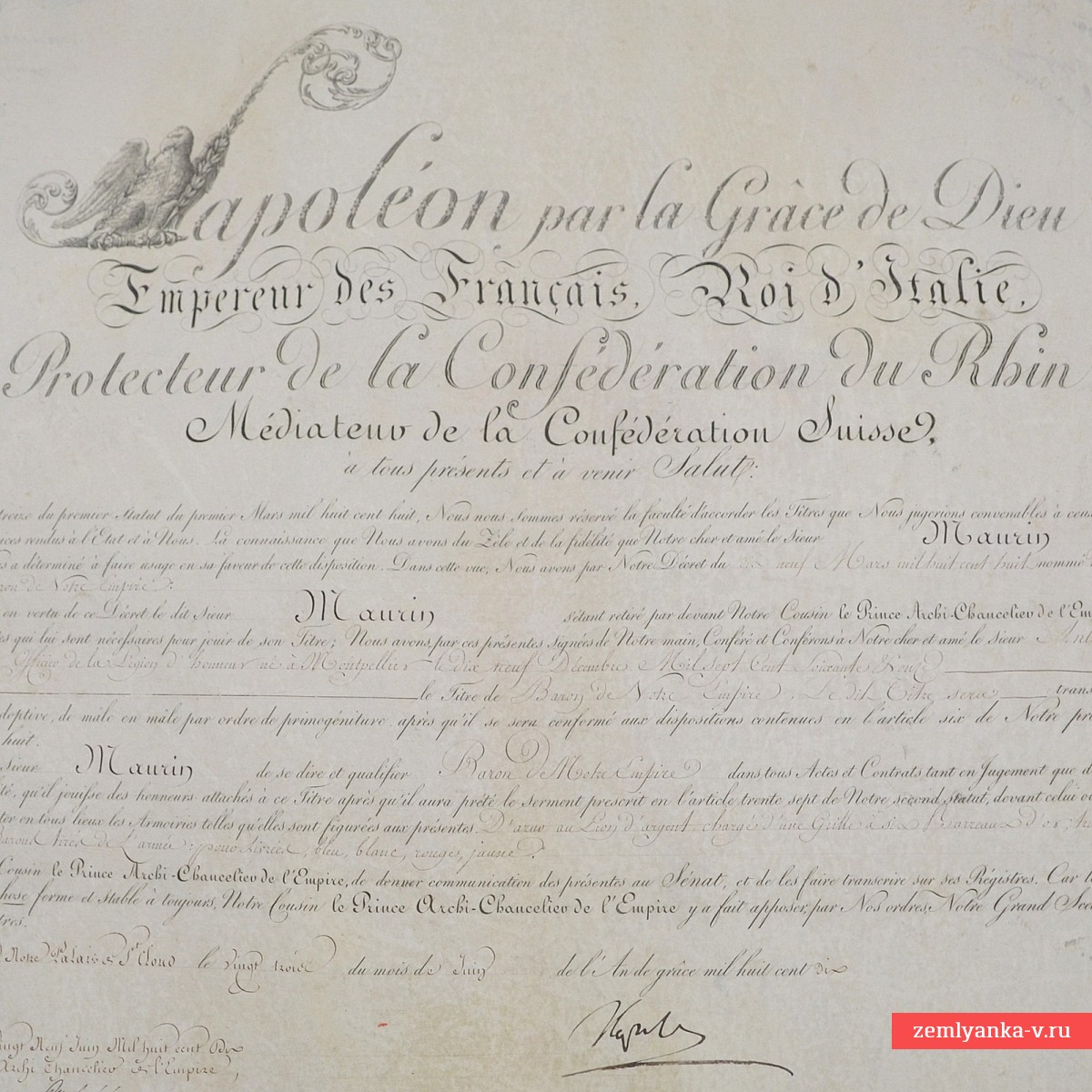
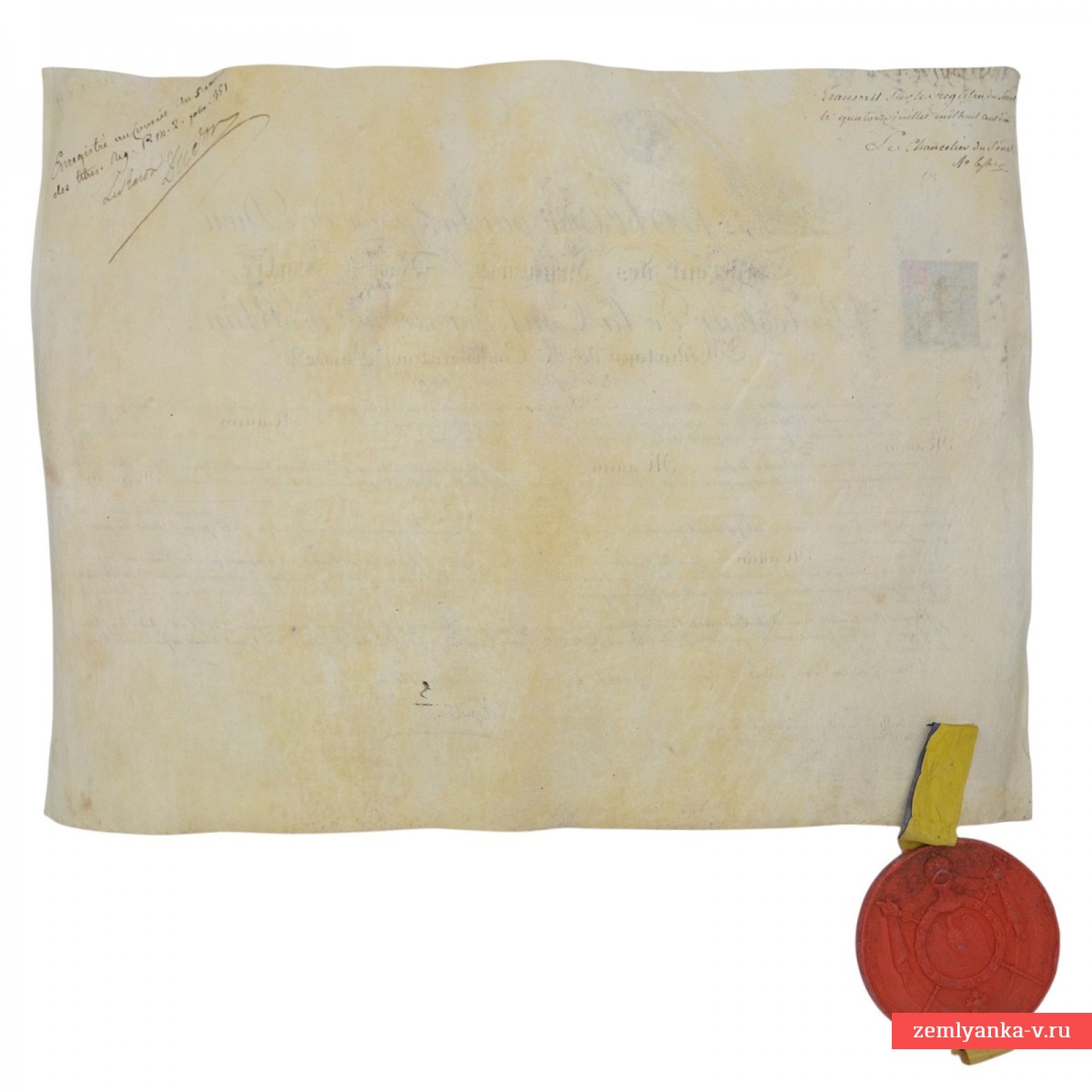
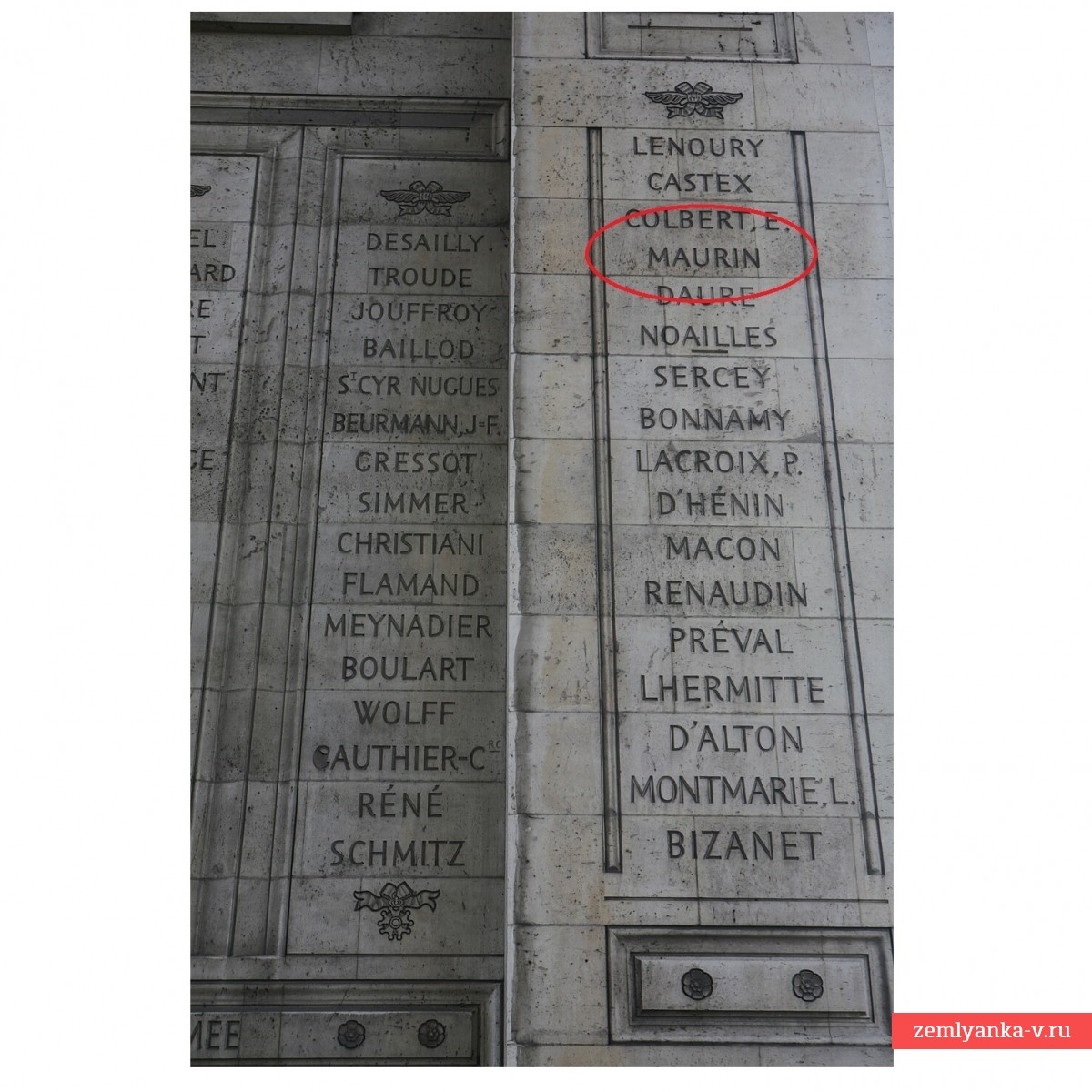
A uniquely rare find, which is an archival document — a certificate of awarding the title of Baron of the Empire to Antoine Morin, whose name is stamped on The Arc de Triomphe in Paris, signed by Napoleon Bonaparte.
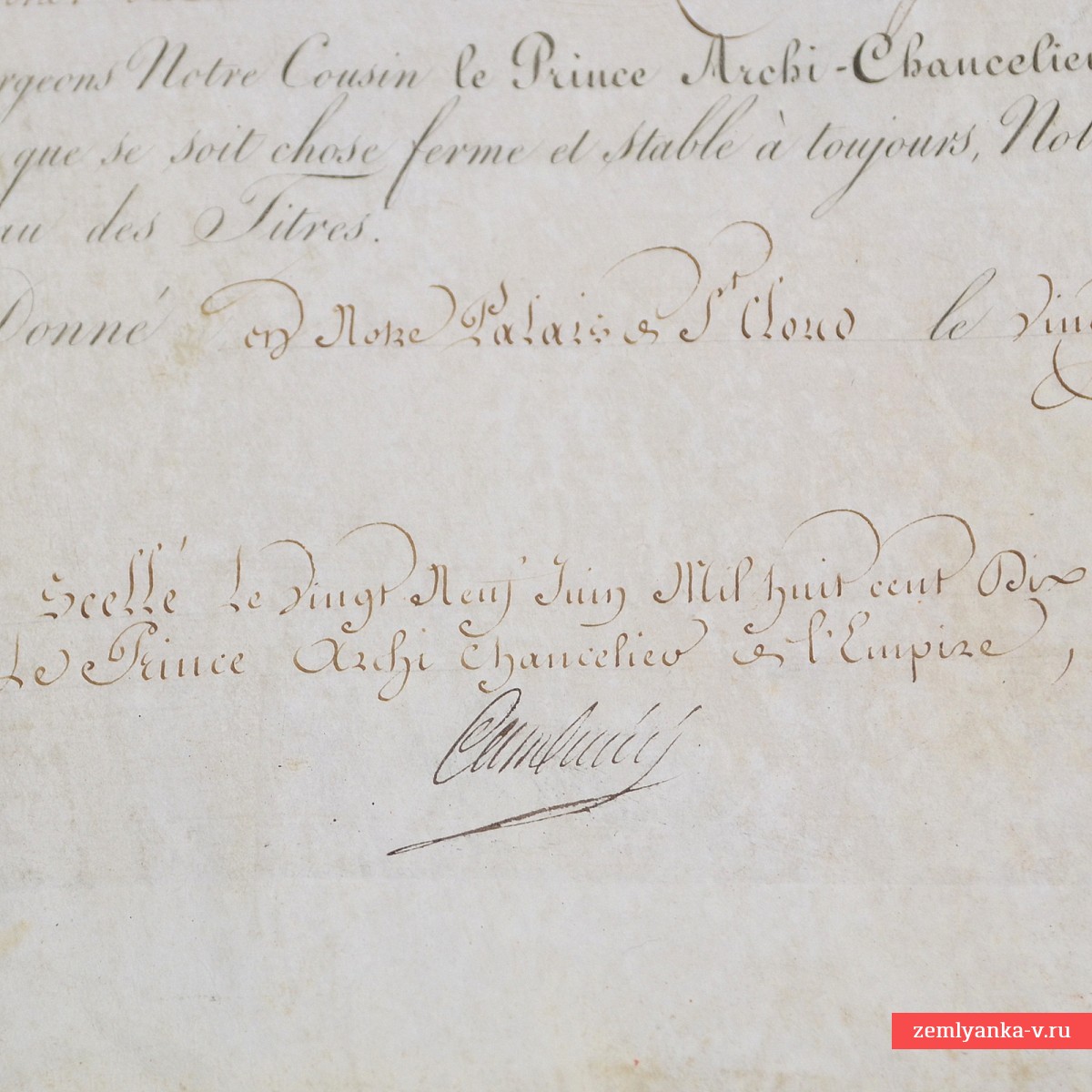
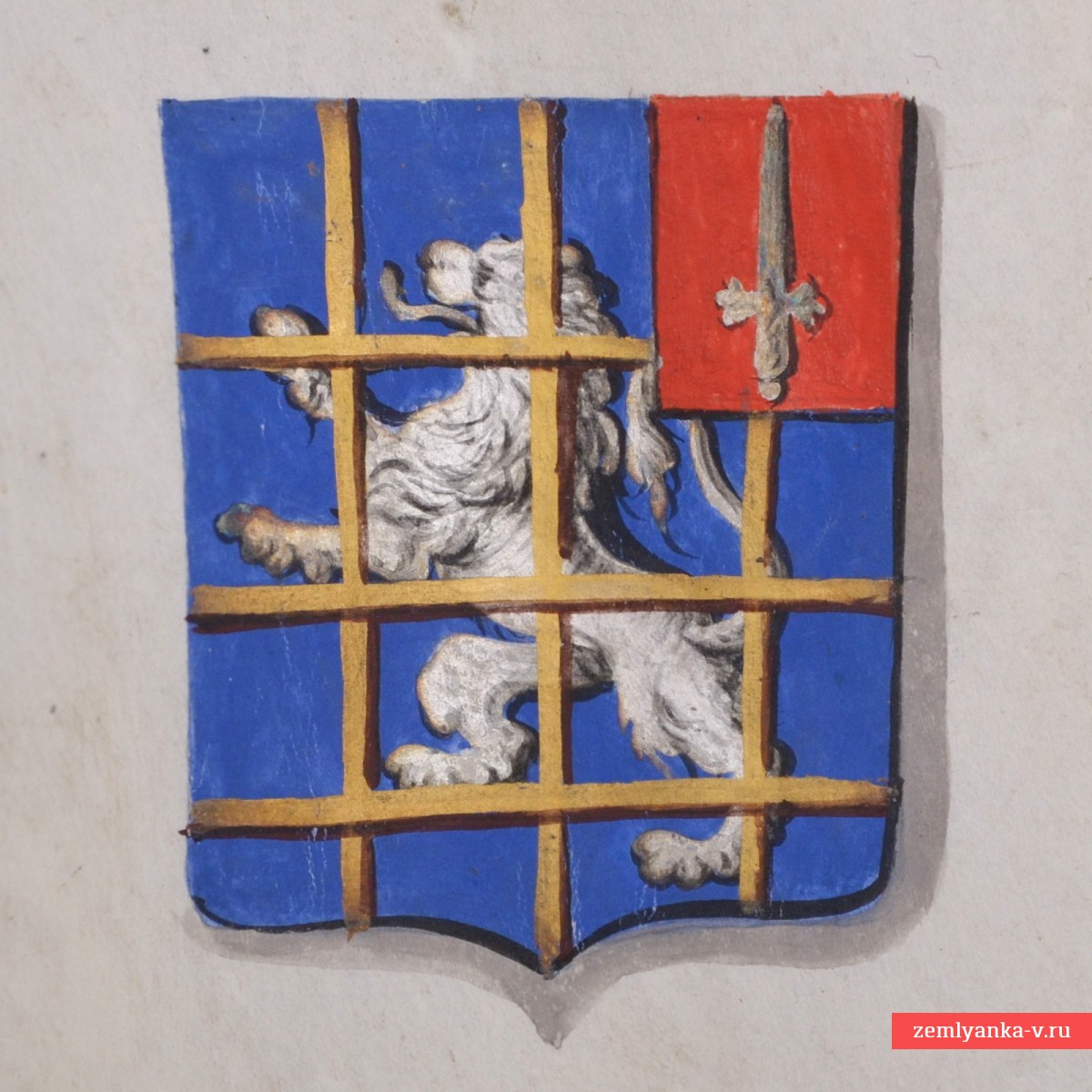
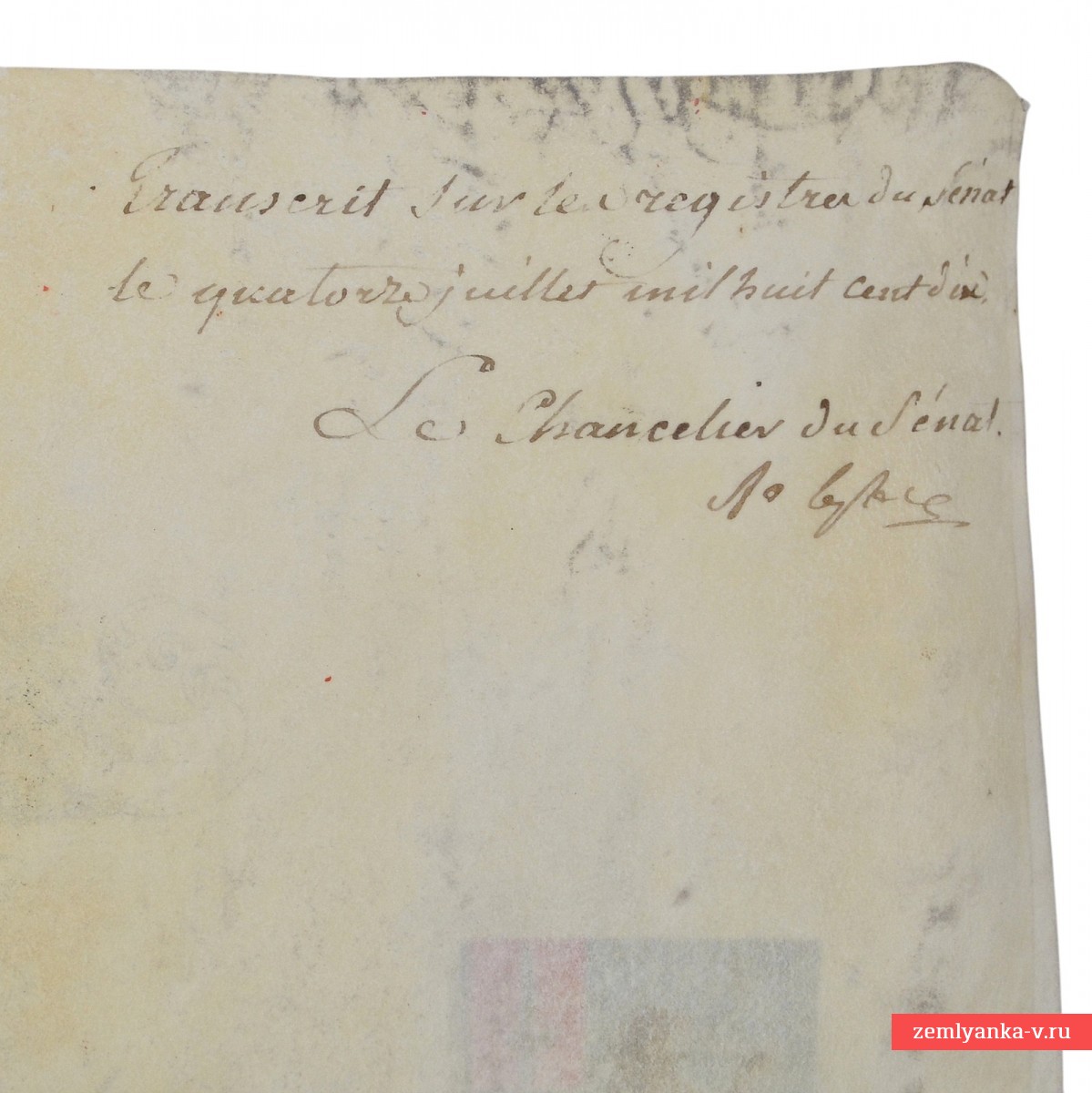
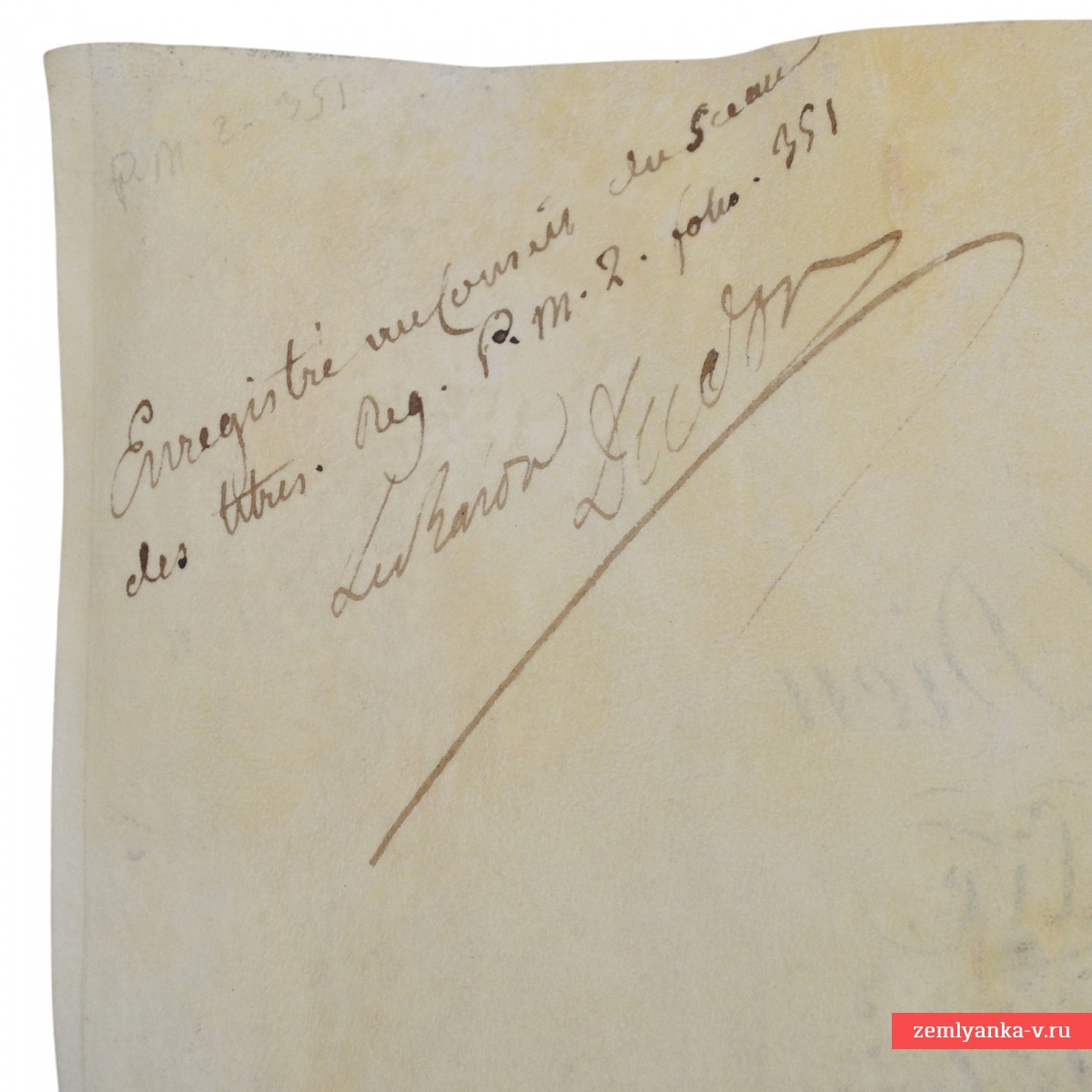
The first step towards the creation of the imperial nobility was taken in 1804, when members of the imperial family received the titles of princes. Napoleon restored almost completely the former system of noble titles (dukes, counts, barons, chevaliers) and noble coats of arms by decree of March 1, 1808. The revival of the institution of nobility, which was bestowed as a reward, formed an elite designed to assert the legitimacy of the existing government and become a reliable pillar of the throne. The majority of titles (about 68%) were awarded for military valor, but the nobility complained about civil service. In total, from 1808 to 1814, 388 people received the title of count, 1,090 received the title of baron, and 1600 received the title of chevalier. The letter is written on behalf of "Napoleon, by the grace of God, Emperor of the French, King of Italy, Protector of the Confederation of the Rhine" and bears his signature–autograph. The document was sealed by Archchancellor Cambaceres and signed by him. There are registration records on the back of the certificate. The award of the title was accompanied by the assignment of a coat of arms, which is described in detail in each document and reproduced in colors. The new system of heraldry was characterized by a stronger sense of hierarchy than the traditional one. When drawing up the coat of arms, a rigid system of additional signs was used to indicate the official functions and positions of its owner. So, the warlords had in the upper left lobe of the coat of arms an image of a silver sword on a red background (as on the studied certificate). The coats of arms of the chevalier or knights of the Empire, as a rule, included one of the heraldic figures, where the silver cross of the Legion of Honor was placed in a red field.
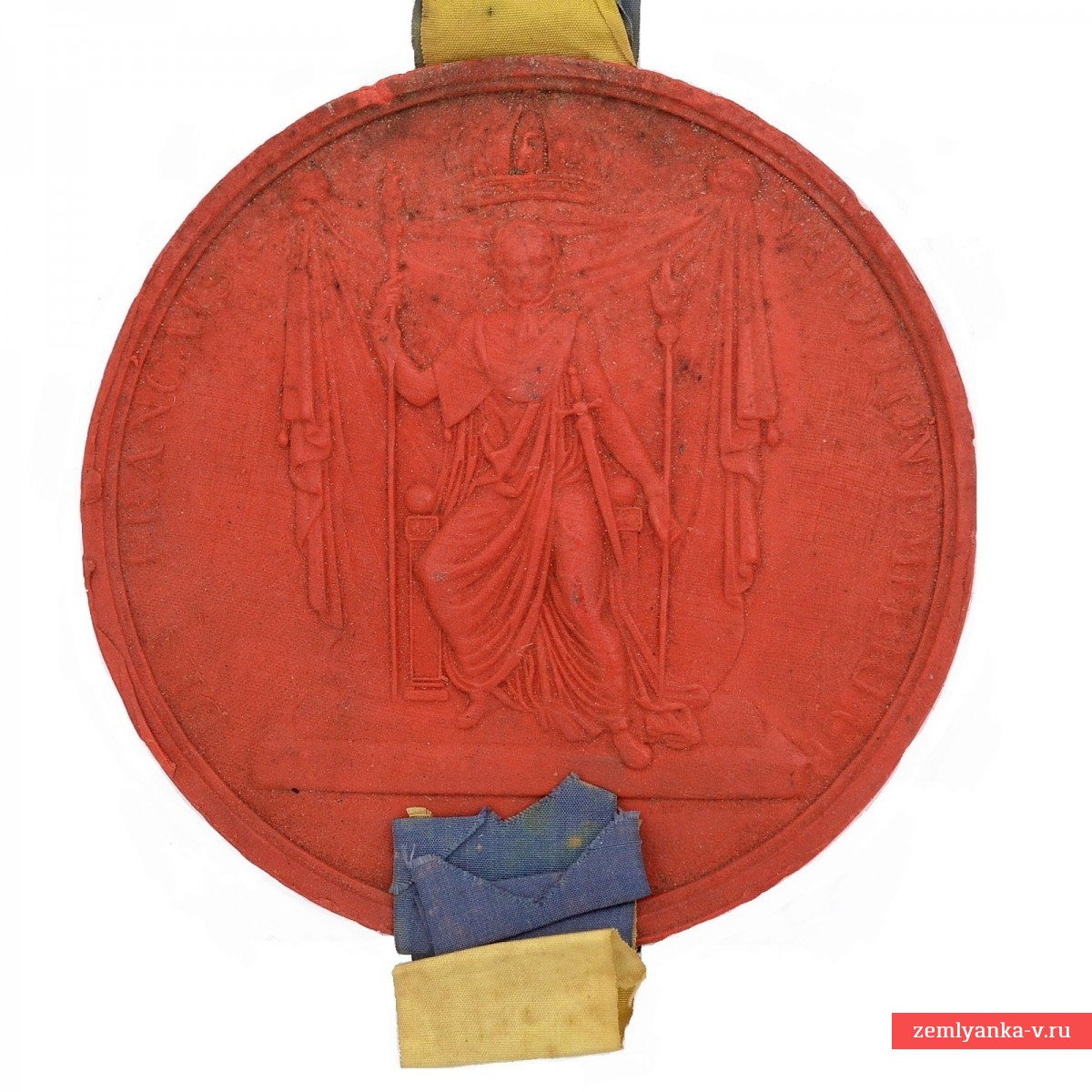
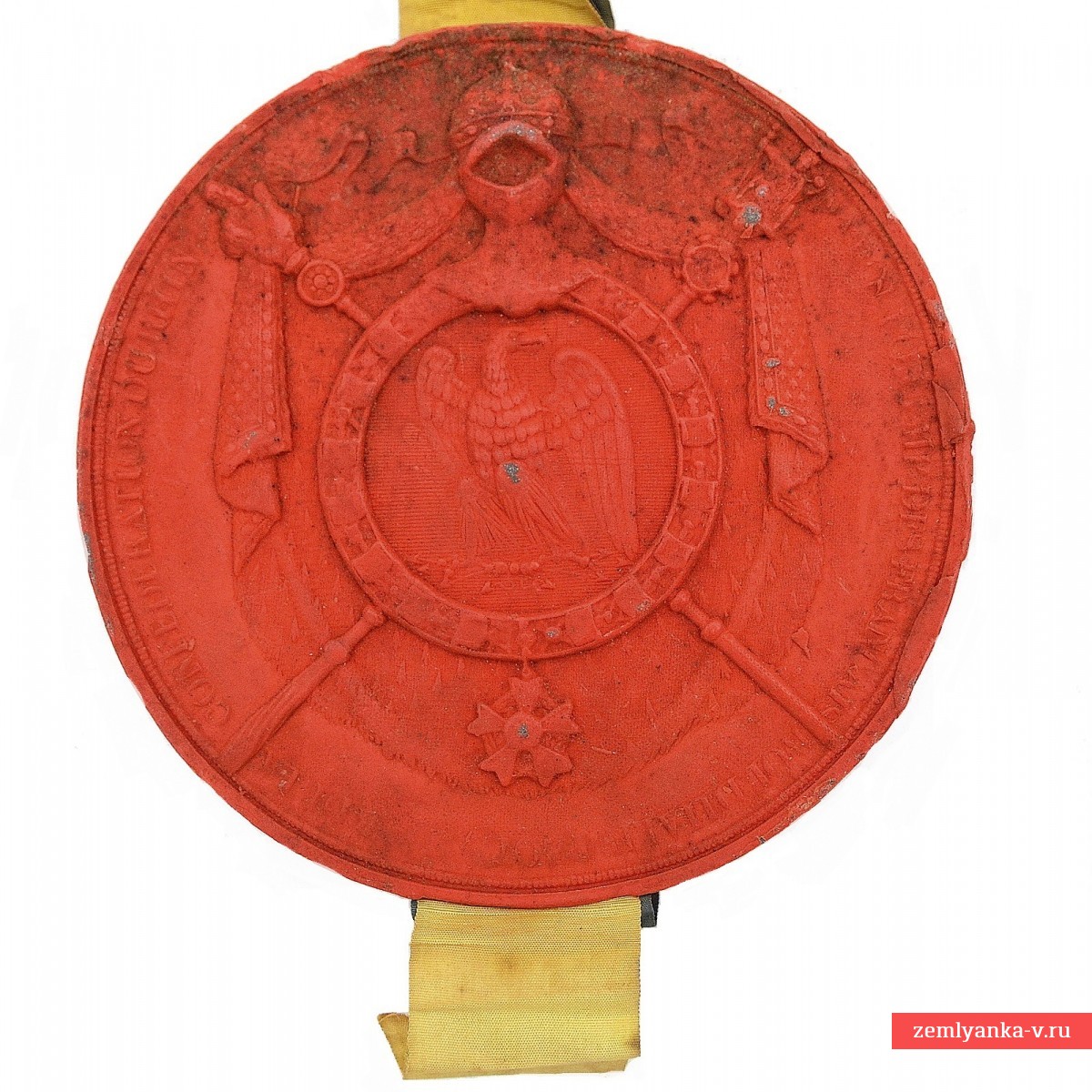
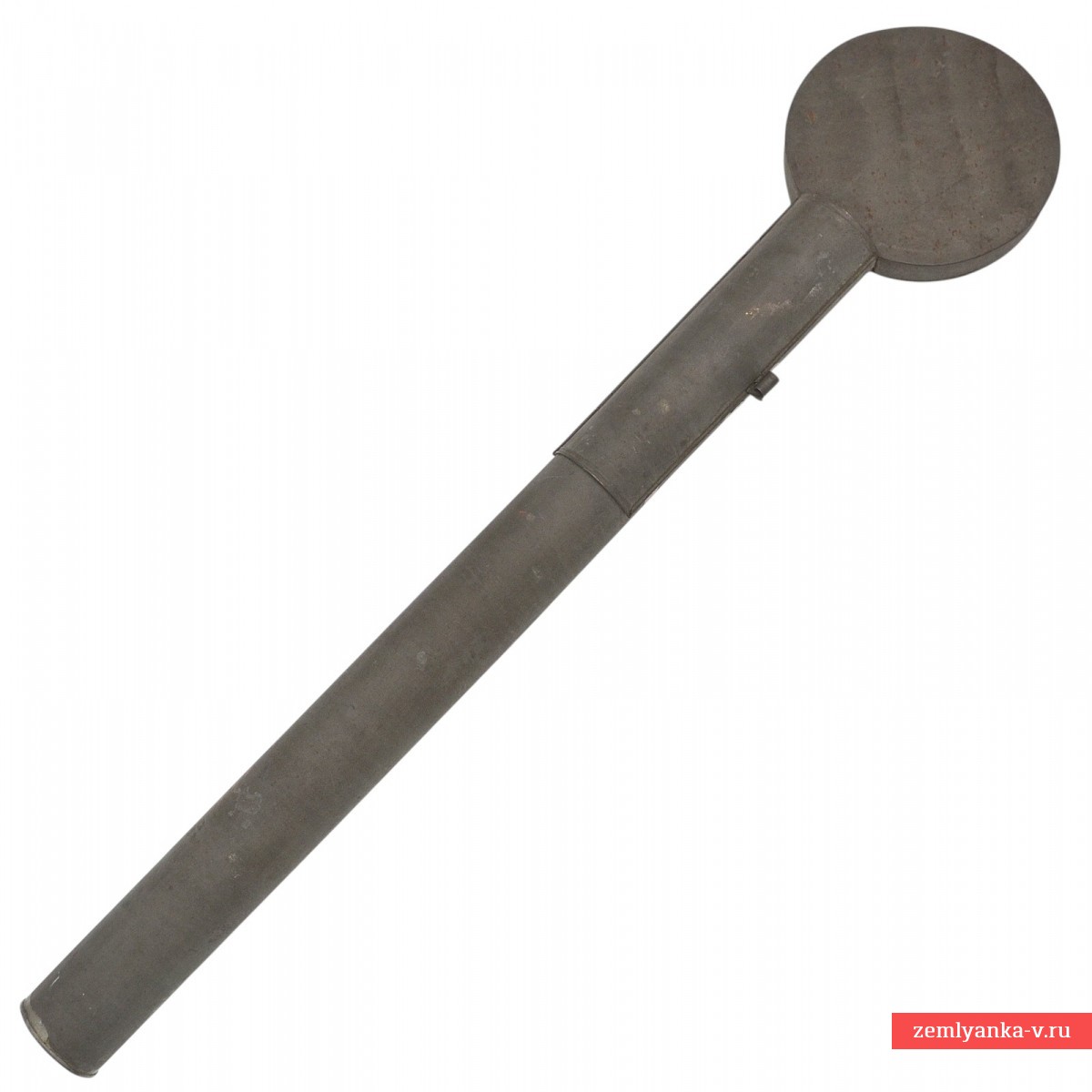
In French. The dimensions are 605*455 mm. A red wax seal with a diameter of 120 mm, with the image of the Imperial Great Coat of Arms on one side and the Emperor in coronation robes on the other. Included is a metal storage case (later). Guarantee of authenticity. Similar documents, according to the website goscatalog.ru They are not recorded in the collections of Russian museums. It's rare.
Antoine Maurin (fr. Antoine Maurin; 1771-1830) was a French military figure, general of division (1814), baron (1810), participant in the Revolutionary and Napoleonic Wars. On July 23, 1792, he joined the 20th Cavalry Chasseur Regiment as a huntsman. On April 18, 1794, he was appointed adjutant to General Mirer. He distinguished himself at the siege of Maastricht and in the battle of the Roer, where he was one of the first to cross the river and attack the enemy. In 1795, he commanded three companies of the grenadier vanguard. His courage contributed to the capture of this city, as well as 800 Austrians captured. On September 13, 1795, he was promoted to second lieutenant of the 20th Cavalry Chasseur. On the night of June 29-30, 1796, at the head of one of the four companies, a grenadier crossed the Rhine by boat at Bendorff. Having thus reached the rear of the enemy, and cutting off the retreat of the 4000th Austrian detachment, which was stationed on the plain at Neuwied. These four companies first captured 200 prisoners, then took a redoubt with artillery and baggage of the enemy general, after which, for more than four hours, they held off the enemy's attacks until the bridge spanning the Rhine prevented the rest of the army from coming to their aid. On September 16, 1796, he distinguished himself during the attack on Limburg, and was promoted to lieutenant by General Jourdan right on the battlefield. On October 2, Biberakh was wounded in the shoulder with a saber. Transferred to the Italian Army, he distinguished himself during the crossing of the Isonzo River under enemy fire and during the capture of Gradisca. For these actions, he was promoted to captain by General Bonaparte right on the battlefield. On April 4, 1797, he was appointed Bernadotte's adjutant.
On April 24, 1802, he was appointed commander of the 24th Cavalry Chasseur Regiment. He served in Italy. In January 1807, his regiment was ordered to go to Poland and join the Grand Army. Since March 28, as part of the Bruyere Brigade of the Lasalle Light Cavalry Division. Distinguished himself at Guttstadt on June 9th. On June 25, 1807, he was promoted to brigadier general. On September 30, he was given command of a cavalry brigade in the 1st Observation Corps of the Gironde. On November 19, he led the vanguard of General Junot's Portuguese Army. In the summer of 1808, Morin fell ill, and on June 19, during the British occupation of Faro, he was captured in his bed. The British transported him to Britain, where he remained as a prisoner until September 4, 1812, when he was able to return to France.
On February 11, 1813, he was summoned to the Emperor's command and enlisted in the Grand Army. On March 1, he became commander of the 9th Brigade of the 4th Light Cavalry Division of the 2nd Cavalry Corps. From December 15 to December 30, without assignment, after which he returned to the 2nd Corps. On January 6, 1814, he was assigned to the cavalry division being formed in Versailles. On February 19, he was promoted to the rank of divisional general. On the same day, the Emperor assigned him command of the 2nd Light Cavalry Division of the 2nd Cavalry Corps. It was at the head of these troops that he conducted the French campaign of 1814.
After the return of the Bourbons, he was appointed commissioner of the King, responsible for the return of prisoners of war. Since January 1, 1815, without an official appointment. On March 19, he was appointed Chief of Staff of the Duke de Berry's 2nd Army Corps. The Emperor, returning to his capital, entrusted him with the command of the 7th Cavalry Division of the 4th Corps of the Northern Army on March 31. On June 16, in the Battle of Linyi, he received a bullet wound in the chest. After the second restoration, he has been without an official appointment since September. On September 18, 1818, he was placed in reserve. Louis XVIII entrusted him with the command of the 15th military District on January 20, 1819. He left this post on May 30, 1820, and was dismissed on January 1, 1823. After the July Revolution, he returned to service with an appointment to the War Ministry. On September 18, 1830, he became the head of the 1st Military District. Seven days later, he was replaced in this post by General Pajol.
Thanks for your feedback!
Your feedback will be published after administrator check.
Be attended, we will not show the feedbacks, which:
Please note that by posting a feedback you take some responsibility to the readers.