94 $
| |
| Marking: | 95891 |
| Country: | USA |
| Dating: | until 1994 year |
| The original. |
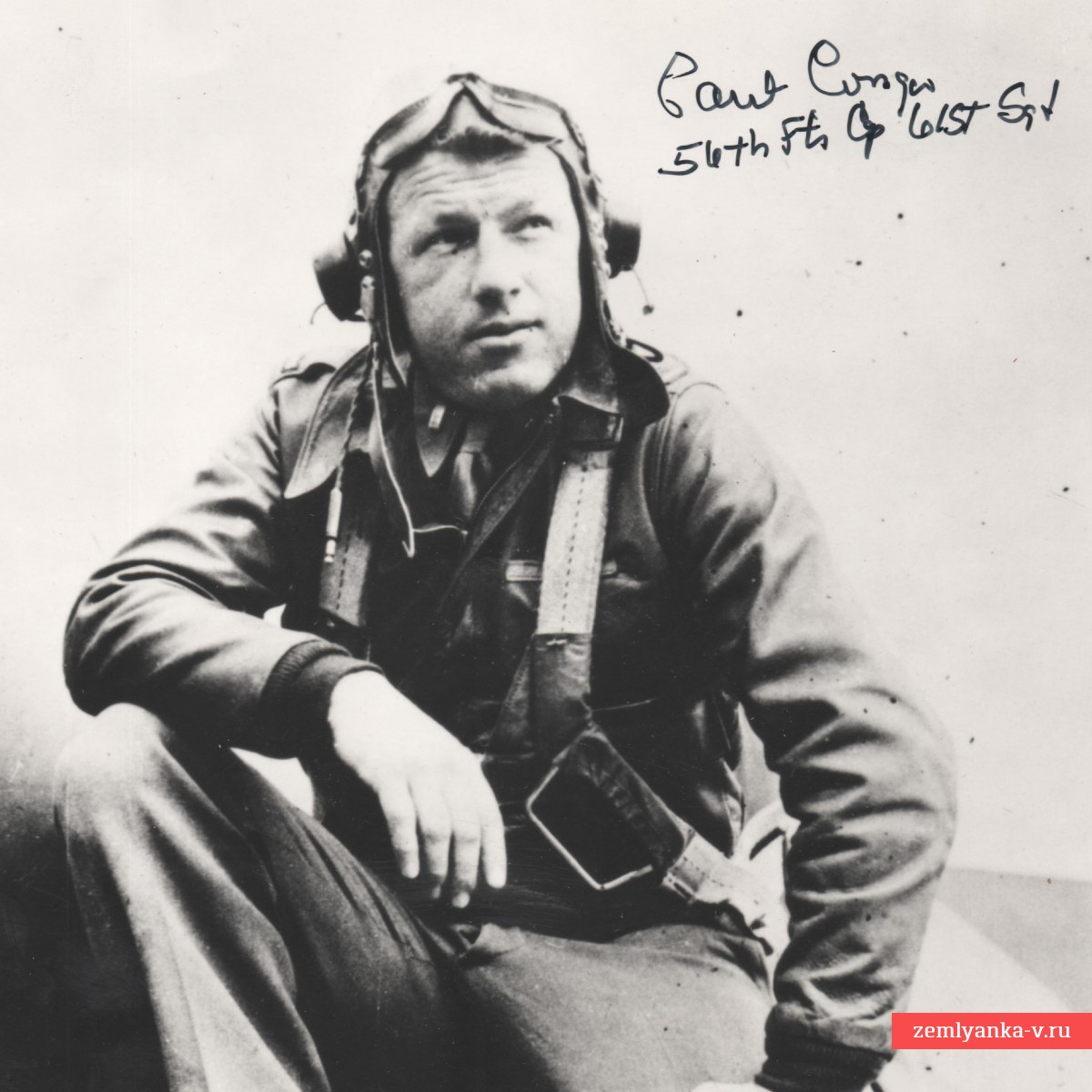
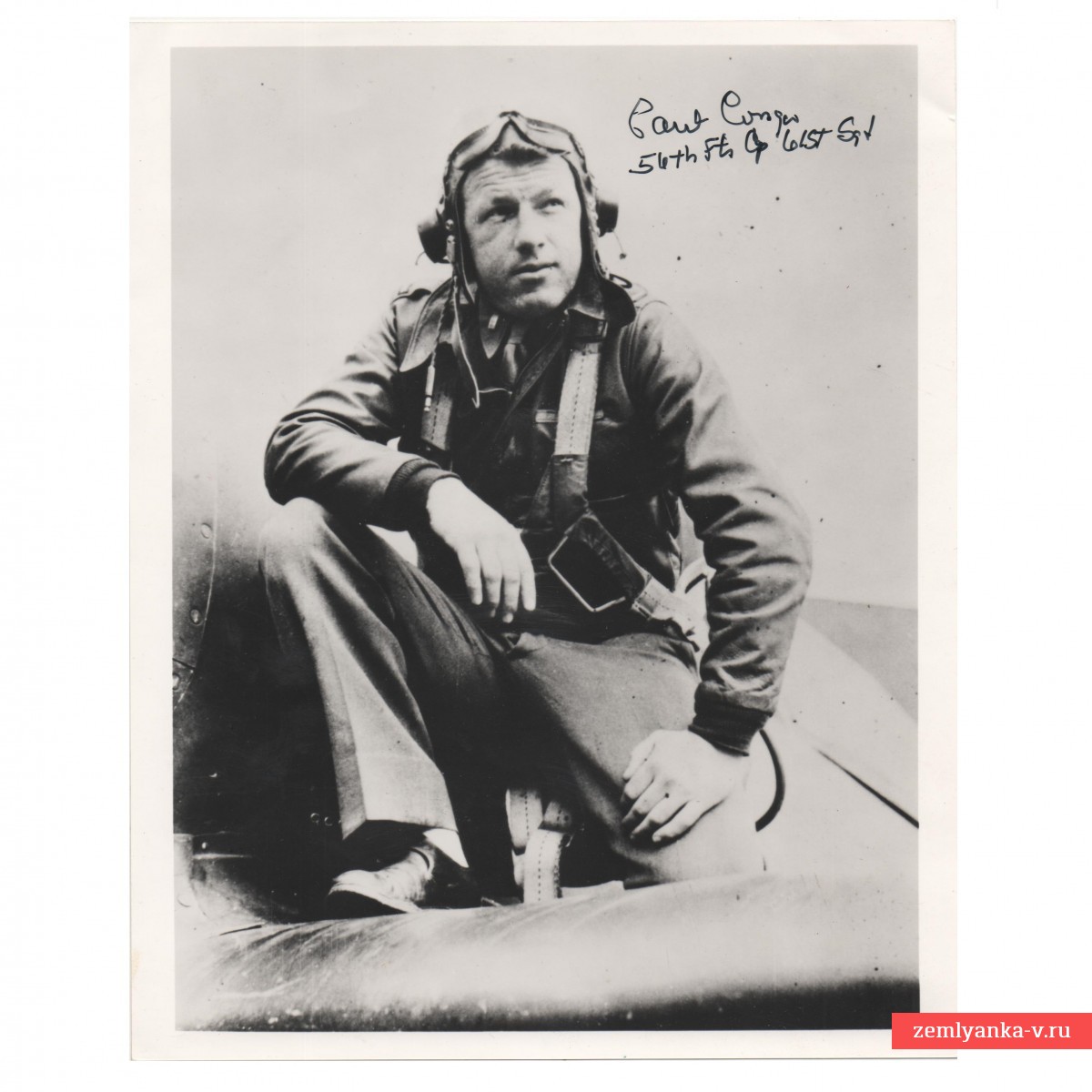
The original photograph, printed in the 1980s and early 1990s and signed by the pilot depicted on it. The size is 200*255 mm. The reverse side is clean. Guarantee of authenticity.
Paul Albert Conger was born on May 3, 1918. He joined the United States Air Force Aviation Cadet Training Program on November 7, 1941. After completing flight training on July 3, 1942, he was promoted to Second Lieutenant in the United States Air Force with pilot qualifications. His next assignment was to retrain on a P-47 Thunderbolt aircraft as part of the 61st Fighter Squadron of the 56th Fighter Group. In January 1943, his unit was transferred to King's Cliff RAF Base, located near King's Cliff, Northamptonshire, 12 miles west of Peterborough in Cambridgeshire, England, and became part of the Eighth Air Force. Kings Cliff was designated USAF Base 367.
On December 11, 1943, then-Captain Paul Albert Conger served in the 61st Fighter Squadron of the 56th Fighter Group of the 8th Air Force in the European Theater of Operations.
On that day, Captain Conger's unit participated in an aerial battle against German troops. Captain Conger piloted a P-47 Thunderbolt fighter jet and led a flight of P-47 fighter jets on a bomber escort mission against a military base in a heavily fortified area near Emden, Germany. Seeing a large number of enemy planes with missiles, escorted by fighters and preparing to attack the bombers, Captain Conger led the attack of his flight against the enemy formation. During the attack, he destroyed one enemy aircraft and damaged another. Thus, Captain Conger and his wingmen dispersed the vastly superior enemy forces and prevented damage to the bombers. While gaining altitude, Captain Conger saw the ME-110 fighter flying with the JU-88 fighter and attacked them, chasing the JU-88 at extremely low altitude and destroying it. He then launched an attack on the ME-110 fighter jet and forced it to fall into the sea. Captain Conger's superb flying skills, courageous actions, and extraordinary heroism that day earned him the U.S. Army's second—highest award for valor, the Distinguished Service Cross.
In December 1944, Conger was transferred to the 63rd Fighter Squadron of the 56th Fighter Group at Base 365 in Halesworth, Suffolk, England. After becoming a major, Conger became the head of the 63rd Fighter Squadron on January 20, 1945 and held this position until March 19. During World War II, Conger shot down a total of 11.5 enemy aircraft in aerial combat and damaged 4 more.
Major Conger participated in the re-establishment of the 56th Fighter Group at Selfridge Field, Michigan, in May 1946, after which he retired from active duty in the United States Air Force. On November 17, 1946, Conger joined the newly created United States Air Force Reserve and served in the Continental Air Command in Los Angeles, California. Lieutenant Colonel Conger retired on February 5, 1958.
Medals, awards:
Distinguished Service Cross,
Distinguished Flying Cross with 4 bronze oak leaves,
Purple Heart Medal (aviation medal) with 2 silver and 3 bronze oak leaves,
Presidential Commendation to the unit with a bronze oak leaf, Medal for
U.S. Defense service,
Medal for participation in the American campaign,
Medal for participation in the European-African-Middle Eastern campaign with 4 bronze stars,
Medal of Victory in the Second World War,
National Defense Service Medal,
Air Force Long Service Award with 4 Bronze Oak Leaves,
Armed Forces Reserve Medal with a bronze Hourglass badge,
The badge of the crew commander.
Thanks for your feedback!
Your feedback will be published after administrator check.
Be attended, we will not show the feedbacks, which:
Please note that by posting a feedback you take some responsibility to the readers.